


Introduction
Materials and Methods
Ethics approval and consent to participate
Experimental animals and treatment
Analysis items and measurements
Statistical analysis
Results and Discussion
Reproduction performance
Sow body composition
Piglet performance
Nutrient digestibility
Conclusion
Introduction
Recent advancements in the domestic swine industry have concentrated on imported lean-type breeds, which require improved management practices for high-performing sows that can achieve larger litter sizes and faster growth rates. Specifically, the reproductive traits of prolific sows during lactation result in significantly heightened nutrient needs (Gauthier et al., 2019; Tokach et al., 2019). This makes amino acid balance crucial for enhancing lactation performance and sustaining body composition (Trottier, 1997; Kim et al., 2009; Zhang and Trottier, 2019).
Valine, a branched-chain amino acid (BCAA), is a key component of body protein (Miura et al., 2006; Wanders et al., 2012). An adequate supply of valine is essential to minimize body protein loss during lactation and to maintain milk production (Lewis and Speer, 1973; Robles-Cabrera and Speer, 1983). The NRC recommends a ratio of standardized ileal digestible valine (SID Val) to lysine (SID Lys) of approximately 0.85 in diets for lactating sows. Insufficient valine relative to lysine may lead to increased mobilization of maternal body protein (Mejia-Guadarrama et al., 2002; NRC, 2012) and compromised lactation performance (Richert et al., 1994). A previous study demonstrated that increasing the SID Val : Lys ratio to 0.88 significantly enhanced both sow backfat thickness and piglet growth performance (Palanisamy et al., 2021). Improved lactation performance is directly linked to the weaning weight of piglets, which can positively affect post-weaning survival rates (Marshall et al., 2006). However, research on valine requirements in prolific sows is still limited (Ball et al., 2008; Ramirez-Camba, 2022), and clear guidelines for optimal valine : lysine (Val : Lys) ratios are not well established (Holen, 2022). The variability in results from previous studies (Carter et al., 2000; Xu et al., 2017) indicates a need for further investigation into the effects of different Val : Lys ratios on overall production parameters in lactating sows (Ball et al., 2008). As modern high-producing sows are nursing larger litters than in previous decades (Theil et al., 2023; Bortolozzo et al., 2023), it is critical to assess whether current valine requirements are still sufficient (Richert et al., 1994; Van der Peet-Schwering and Bikker, 2019). Therefore, this study seeks to evaluate the impact of varying Val : Lys ratios in lactating sow diets on body composition, lactation performance, and piglet performance, as well as to establish the optimal Val : Lys ratio.
Materials and Methods
Ethics approval and consent to participate
The animal experimental protocols used in this study were approved by the Institutional Animal Care and Use Committee of Chungbuk National University (approval no. CBNUA-25-0052-01).
Experimental animals and treatment
Twenty pregnant sows of a three-way crossbreed [(Landrace × Yorkshire) × Duroc] at parity 2 - 3, with initial body weight (BW) of 219.00 ± 4.81 kg, were obtained from a local farm (Somang Farm, Ganghwa-gun, Incheon, Korea) and used in this experiment for d 21. All sows were assigned to four completely randomized treatment groups based on initial BW. The treatments were as follows: 69, sows fed a basal diet with SID Val : Lys ratio of 69%; 83, sows fed a basal diet with SID Val : Lys ratio of 83%; 103, sows fed a basal diet with SID Val : Lys ratio of 103%; 123, sows fed a basal diet with SID Val : Lys ratio of 123%. The basal diet was formulated to meet or exceed the NRC (2012) nutrient requirements for lactating sows. The SID Val : Lys ratios were selected to range from 69 to 123%, encompassing both deficient and surplus levels relative to the current NRC recommendation (85%), to determine the optimal ratio for modern high-prolific sows. Each treatment included one sow per cage, sized 2.5 m in width, 1.8 m in depth, and 0.5 m in height. Sows were transferred to farrowing crates at 110 d of gestation after cleaning. The farrowing facility was maintained at 20 ± 2℃ with temperature control units and ventilation fans. Heat lamps were provided to maintain temperature and physiological stability for piglets. A basal diet was fed to all treatments during the experimental periods, with varying levels of L-valine supplemented in each group (Table 1). Feed was offered from the day after parturition, three times daily (07:00, 12:00, 17:00). Feed intake was gradually increased by 600 g·d-1 (200 g per feeding) until 6 d postpartum, after which sows had ad libitum access to feed and water throughout lactation. Piglets were assigned at birth by litter within the same treatment group and fed identical diets for five weeks during the post-weaning period. Piglets were tail-docked and male piglets were castrated within 72 h of birth. All piglets received an intramuscular injection of iron (gleptoferron, Ceba Gleptosil, Ceva Korea, Korea) at 1.5 mL per head.
After weaning at d 21, piglets were housed together and fed experimental diets formulated according to NRC requirements for five weeks post-weaning (NRC, 2012). Feed and water were provided ad libitum throughout the experimental period.
Analysis items and measurements
Reproductive performance
Sow daily feed intake and litter size were recorded. To determine mortality and the number of piglets at nursing onset and weaning (d 21), the total number of piglets was monitored daily throughout the experimental period.
Sow body composition
To evaluate physiological changes in sows, BW and backfat thickness at P2 point were measured within 24 h after parturition and at 21 d of lactation using an ultrasonic device (Piglog 105, SFK Technology, Denmark).
Piglet performance
BW was measured within 24 h after birth, at weaning (3 weeks old), and at the end of the experiment (8 w) to evaluate piglet growth performance and sow lactation performance.
Nutrient digestibility
To measure nutrient digestibility in lactating sows, chromic oxide (Cr2O3) was added to the experimental diet at 0.2% from 7 days before the end of the lactation period. Fecal samples were collected via rectal massage from all sows during the weaning period and stored at -20℃ until analysis. Prior to analysis, fecal samples were dried at 60℃ for 72 hours and then ground using a Willey mill. Samples were analyzed according to AOAC methods for dry matter (DM; method 934.01) (AOAC, 2005). Crude protein (CP) was measured using a DUMAS analyzer (Rapid MAX N-Exceed, Elementar, Germany), and gross energy (GE) was determined using an adiabatic bomb calorimeter (Model 6400 Parr Instrument, USA). Nutrient digestibility was calculated using the following Eq. (1).
Statistical analysis
Data on reproductive performance, body composition, piglet performance, and nutrient digestibility were statistically analyzed by one-way ANOVA using JMP (2021). Differences between treatment means were determined using Tukey’s multiple-range test. A probability level of p < 0.05 was indicated to be statistically significant, and a level of 0.05 ≤ p < 0.10 was considered to have such a tendency. Additionally, linear-quadratic responses to SID Val : Lys levels were analyzed using orthogonal polynomial contrasts.
Table 1.
Composition of experimental diets (as-fed-basis).
| Items | SID valine : lysine ratio (%) | |||
| 69 | 83 | 103 | 123 | |
| Ingredients (%) | ||||
| Corn | 62.50 | 62.33 | 62.16 | 61.99 |
| Soybean meal (44%) | 12.70 | 12.70 | 12.70 | 12.70 |
| Peanut meal (43%) | 10.00 | 10.00 | 10.00 | 10.00 |
| Wheat bran | 8.00 | 8.00 | 8.00 | 8.00 |
| Soybean oil | 2.80 | 2.80 | 2.80 | 2.80 |
| Dicalcium Phosphate | 1.70 | 1.70 | 1.70 | 1.70 |
| Limestone | 1.00 | 1.00 | 1.00 | 1.00 |
| L-lysine | 0.30 | 0.30 | 0.30 | 0.30 |
| DL-methionine | 0.05 | 0.05 | 0.05 | 0.05 |
| L-threonine | 0.10 | 0.10 | 0.10 | 0.10 |
| L-valine | 0.05 | 0.22 | 0.39 | 0.56 |
| Salt | 0.30 | 0.30 | 0.30 | 0.30 |
| Vitamin and mineral premixz | 0.50 | 0.50 | 0.50 | 0.50 |
| Total | 100.00 | 100.00 | 100.00 | 100.00 |
| Calculated value | ||||
| ME (kcal·kg-1) | 3,311 | 3,311 | 3,311 | 3,311 |
| CP (%) | 17.12 | 17.10 | 17.07 | 17.01 |
| SID lysine (%) | 0.98 | 0.98 | 0.98 | 0.98 |
| SID methionine (%) | 0.35 | 0.35 | 0.35 | 0.35 |
| SID valine (%) | 0.68 | 0.81 | 1.01 | 1.21 |
| SID valine : lysine | 0.69 | 0.83 | 1.03 | 1.23 |
| Ca (%) | 0.86 | 0.86 | 0.86 | 0.86 |
| P (%) | 0.57 | 0.57 | 0.57 | 0.57 |
z Provided per kg of complete diet: vitamin A, 12,000 IU; vitamin D3, 2,000 IU; vitamin E, 24 IU; vitamin K3, 2.0 mg; thiamine, 2.0 mg; riboflavin, 6.0 mg; pyridoxine, 4 mg; vitamin B12, 24 ng; niacin, 30 mg; pantothenic acid, 20 mg; folic acid, 3.6 mg; biotin, 0.4 mg; choline chloride, 0.4 mg; iron, 96 mg; copper, 8.0 mg; zinc, 120 mg; manganese, 40 mg; iodine, 0.56 mg; selenium, 0.4 mg.
Results and Discussion
Reproduction performance
The effect of the SID Val : Lys ratio in lactating sow diets on reproductive performance is summarized in Table 2. The study found no significant differences in daily feed intake, litter size, number of piglets at nursing onset, number of weaned piglets, or piglet mortality among the treatment groups (treatment p > 0.05). This indicates that adjustments to the Val : Lys ratio do not affect sow reproductive performance or lactation ability. Similarly, Greiner et al. (2019) reported that dietary Val : Lys ratios ranging from 50 to 100% did not significantly influence the number of piglets at nursing onset or the number of weaned piglets. Additionally, Xu et al. (2017) found that increasing dietary Val : Lys ratios (from 63 to 123%) enhanced sow feed intake without significantly affecting piglet mortality. This effect may be linked to metabolic regulation concerning lysine requirements, rather than direct effects of valine itself (Craig et al., 2016). Moreover, a deficiency in valine can lead to feed rejection and reduced feed intake (Gloaguen et al., 2012). Therefore, the Val : Lys ratios established in this study (69 to 123%) do not appear to adversely affect sow reproductive performance or feed intake.
Table 2.
Effect of optimizing dietary valine-to-lysine ratio during late gestation and (or) lactation on body composition and lactation performance of sow.
Sow body composition
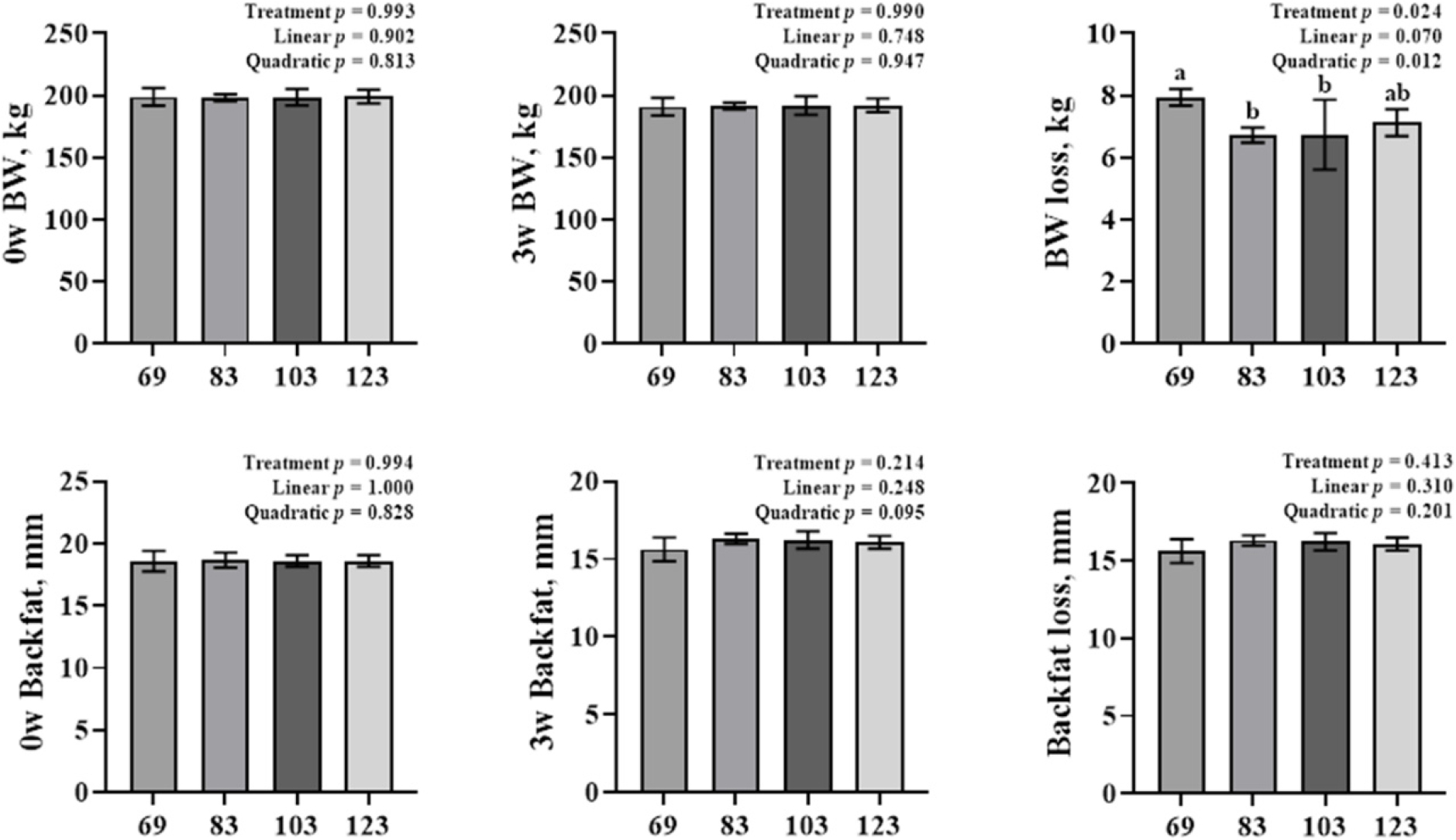
The effect of the SID Val : Lys ratio on sow body composition is shown in Fig. 1. No significant differences in BW or backfat thickness were observed among treatment groups. However, the 69% SID Val : Lys treatment resulted in greater BW loss compared to the 83% and 103% treatments (treatment p < 0.05; linear p = 0.07; quadratic p < 0.05). This suggests that a SID Val : Lys ratio below 83% may compromise body protein metabolism. As a BCAA, valine is involved in mammary and energy metabolism; a deficiency can hinder body composition maintenance in sows (Che et al., 2021). The greater BW loss observed at the 69% ratio suggests that the supply of valine may have been insufficient to meet the physiological demands of the lactating sow. Despite this, there were no significant differences in backfat thickness loss among treatments. Previous studies have indicated that backfat loss decreases when feed intake increases during lactation (Xu et al., 2017). According to King and Dunkin (1986), there is a negative correlation between backfat loss in lactating sows and feed intake. Consequently, these results suggest that when the Val : Lys ratio falls below adequate levels, it negatively impacts the maintenance of sow BW.
Piglet performance
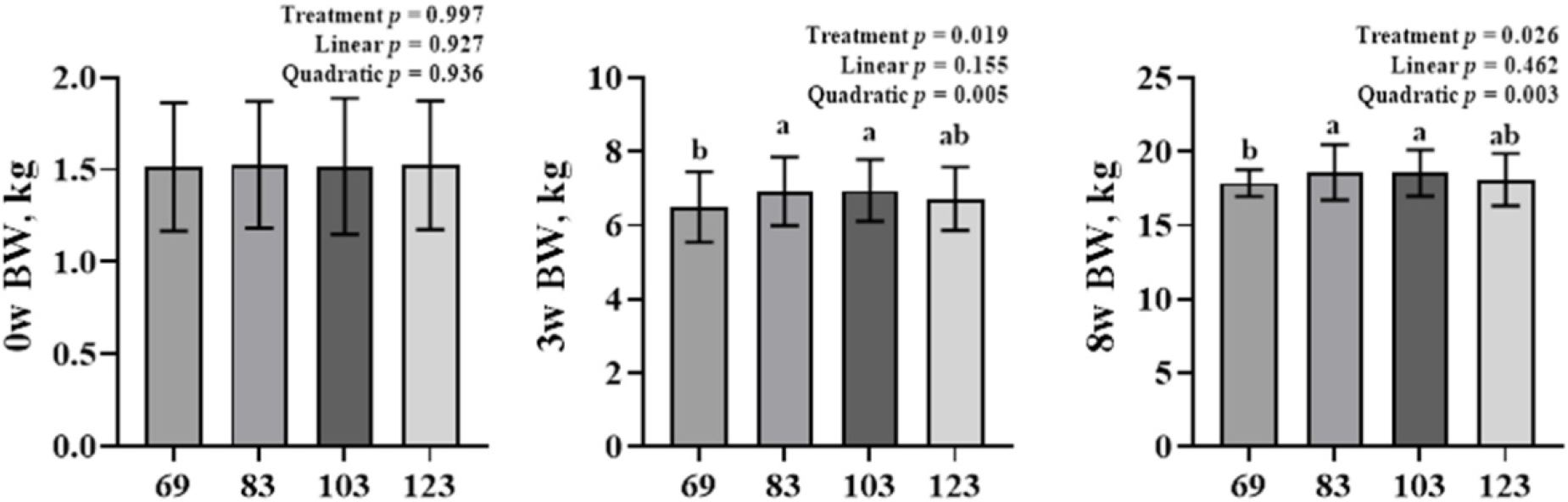
The effect of SID Val : Lys ratio in lactating sow diets on piglet performance is presented in Fig. 2. There were no significant differences in birth weight among the treatment groups. However, piglet BW at weeks 3 and 8 was significantly lower in the 69% SID Val : Lys treatment compared to the 83% and 103% treatments (treatment p < 0.05; quadratic p < 0.05). This suggests that an inadequate supply of valine relative to lysine hampers piglet growth during both the lactation and post-weaning phases. Supporting these findings, Palanisamy et al. (2021) reported that when the Val : Lys ratio in sow diets dropped below 88%, weaning weights of piglets were significantly reduced. This may suggest that an inadequate Val : Lys ratio could potentially impair nutrient transfer from the sow to the piglets. Previous research has also shown that a 68% Val : Lys ratio resulted in lower milk fat content compared to a 110% ratio (Craig et al., 2016). Additionally, as the Val : Lys ratio increased, the proportion of essential amino acids in colostrum rose, significantly enhancing the average daily gain of nursing piglets (Xu et al., 2017). Therefore, the results of this study indicate that when the Val : Lys ratio in lactating sow diets falls below adequate levels, it adversely affects the nutrient composition of milk, ultimately leading to reduced piglet productivity. The impaired growth performance observed at the 69% Val : Lys ratio reflects compromised maternal nutrient transfer, which adversely affected piglet development during the nursery period.
Nutrient digestibility
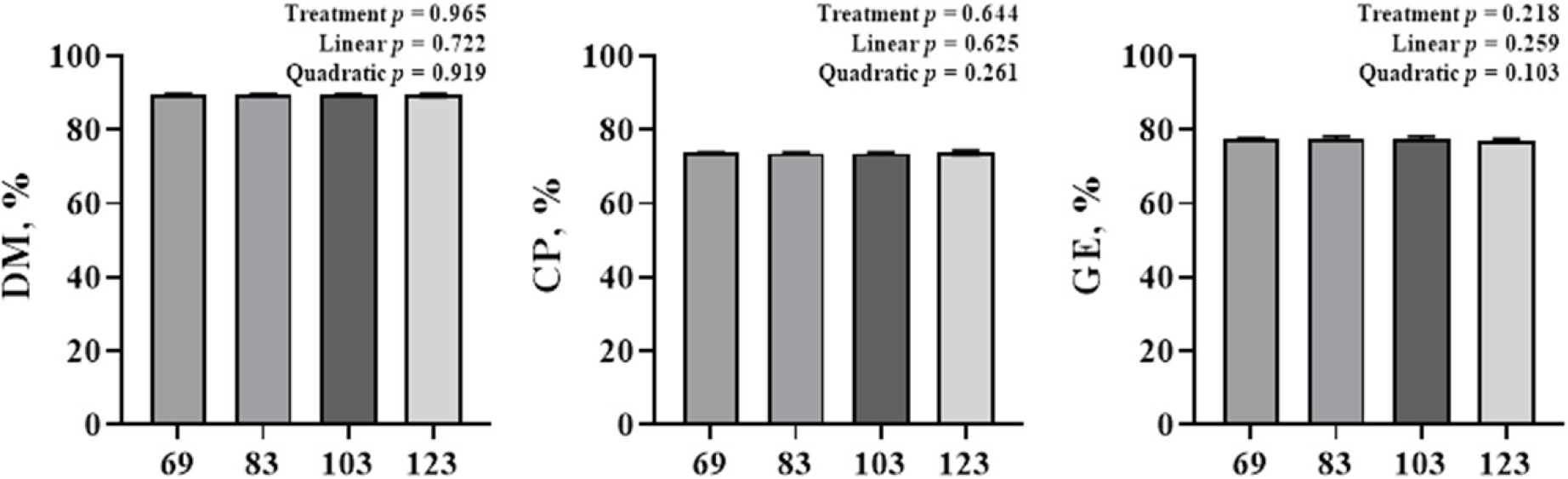
The effect of SID Val : Lys ratio in lactating sow diets on nutrient digestibility is presented in Fig. 3. There were no significant differences in DM, CP, and GE digestibility among the treatment groups (treatment p > 0.05). Previous research has indicated that changes in amino acid balance can influence digestibility in weaned piglets and finishing pigs (Son et al., 2019). However, lactating sows have well-developed gastrointestinal structures and functions, which may limit the potential for distinct variations in digestibility due to differences in the Val : Lys ratio (Lowell et al., 2015). This suggests that the mature digestive system of lactating sows is adaptable to changes in dietary amino acid composition. Additionally, prior studies have shown that high levels of essential amino acids in sow diets do not directly affect protein and energy digestibility, a finding that aligns with the current results (Theil et al., 2023). The lack of significant treatment effects on nutrient digestibility in this study suggests that the Val : Lys ratio may not have a detrimental impact on the overall digestive processes in lactating sows. Consequently, these results imply that the Val : Lys ratio impacts productivity parameters and metabolic responses rather than nutrient digestibility itself. While not directly measured in this study, the improvements in sow body composition and piglet performance could be attributed to optimized maternal metabolism and milk synthesis, as suggested by previous studies.
Conclusion
This study evaluates the effects of SID Val : Lys ratio in lactating sow diets on the productivity of both lactating sows and nursing piglets. In this study, no significant differences were observed among treatment groups in sow backfat thickness, number of piglets at nursing onset, number of weaned piglets, nutrient digestibility, or piglet birth weight. However, the 69% SID Val : Lys treatment resulted in greater BW loss compared to the 83% and 103% treatments, and piglet BW at weeks 3 and 8 were significantly reduced. Conversely, at 83 to 103% ratios, sow body composition and piglet productivity remained stable. These findings suggest that low valine levels (69% SID Val : Lys) result in reduced maternal body composition, which may have a potential impact on milk production or nutrient quality, ultimately affecting piglet growth. Therefore, to prevent negative impacts on lactating sows while improving sow BW and piglet weaning weight, an SID Val : Lys ratio of 83 to 103% in lactating sow diets is recommended as the optimal range. This optimal range exceeds the NRC (2012) recommendation of 85%, suggesting that modern high-producing sows nursing large litters may require higher Val : Lys to maintain adequate nutrient transfer through milk and support optimal performance.