


Introduction
Materials and Methods
Study areas
Sample collection
Target compounds
Standards and reagents
Sample preparation and instrumental analysis
Statistical analysis
Results
Environmental occurrence in environmental matrices
Detection characteristics in prey organisms and stork-related samples
Statistical comparison of fipronil sulfone concentrations
Food-web transfer and biomagnification factor (BMF)
Discussion
Differential environmental distribution of DDT and fipronil sulfone
Ecological implications of pesticide persistence in agricultural wetland ecosystems
Conclusion
Introduction
Agricultural wetland ecosystems consist of complex environmental structures in which soils, aquatic systems, and diverse biological communities are interconnected (Mitsch and Gosselink, 2007). Contaminants can be redistributed within ecosystems not only through movement among environmental matrices but also through biological transfer via food webs (Kelly et al., 2007). In agricultural areas characterized by rice paddy wetlands and irrigation channels, rainfall runoff, sedimentation, and biological feeding processes occur repeatedly, increasing the possibility that residual contaminants continuously migrate among soils, aquatic systems, and organisms. Therefore, understanding contamination characteristics in agricultural wetland ecosystems requires consideration not only of environmental concentrations but also of food-web-based transfer processes and biomagnification characteristics in higher trophic levels (Borgå et al., 2012). Persistent organic pollutants (POPs) are well known as representative environmental contaminants because of their high environmental persistence and lipophilic properties, which enable transfer to upper trophic predators through food webs (Jones and de Voogt, 1999). Dichlorodiphenyltrichloroethane (DDT), a representative organochlorine pesticide, continues to be detected in environmental and biological samples despite its ban, and its major metabolite, p,p′-dichlorodiphenyldichloroethylene (p,p′-DDE), has been reported to exhibit high stability and bioaccumulation potential (Turusov et al., 2002). In contrast, fipronil is a phenylpyrazole insecticide currently used in agricultural environments and forms the metabolite fipronil sulfone through environmental degradation processes. Previous studies have reported toxic effects of fipronil and its metabolites on aquatic organisms and amphibians (Gunasekara et al., 2007; Wang et al., 2016). These compounds may therefore exhibit different environmental mobility and food-web transfer characteristics even within the same ecosystem.
The oriental stork (Ciconia boyciana) is a representative bioindicator species occupying the upper trophic level in wetland ecosystems and primarily feeds on fish, amphibians, and various aquatic organisms. Because oriental storks occupy a high trophic position, they can reflect contaminant transfer characteristics through food webs and therefore provide important ecological information for ecosystem-based risk assessment (Burger and Gochfeld, 2004).
Yesan County, Chungcheongnam-do, is a representative inland agricultural region where a managed oriental stork restoration project linked to environmentally friendly agricultural policies has been implemented around the Yesan Stork Park (Mitsch and Gosselink, 2007; YEHWANG, 2025), and some prey organisms are supplied externally. In contrast, the Taean region is characterized by a mixture of conventional and environmentally friendly agricultural environments, and such land-use characteristics may influence spatial differences in pesticide exposure patterns. In addition, naturally released storks utilize natural prey organisms within wider home ranges. These regional differences suggest that contaminant exposure pathways and food-web transfer patterns may differ even within agricultural wetland ecosystems.
Previous studies confirmed the occurrence of p,p′-DDE through biomonitoring using stork eggs, and the potential occurrence of fipronil sulfone was also reported in some environmental and biological samples (Lee et al., 2026). However, the previous study mainly focused on biological monitoring using stork eggs and thus had limitations in comprehensively explaining environmental distribution characteristics and food-web-based transfer structures of contaminants. In particular, integrated interpretation of transfer characteristics among soils, stream water, prey organisms, and upper trophic predators was insufficient.
Therefore, this study aimed to evaluate the environmental distribution and food-web transfer characteristics of persistent pesticides within agricultural wetland ecosystems by using a restored oriental stork (Ciconia boyciana) population inhabiting both managed feeding environments and post-release natural food-web environments. To achieve this, soil, stream water, prey organisms, stork eggs, feathers, and regurgitated material samples were analyzed. By comparing managed feeding environments with post-release natural food-web environments within the same restored stork population, this study provides an integrated assessment of contaminant exposure pathways and food-web transfer characteristics in agricultural wetland ecosystems.
Materials and Methods
Study areas
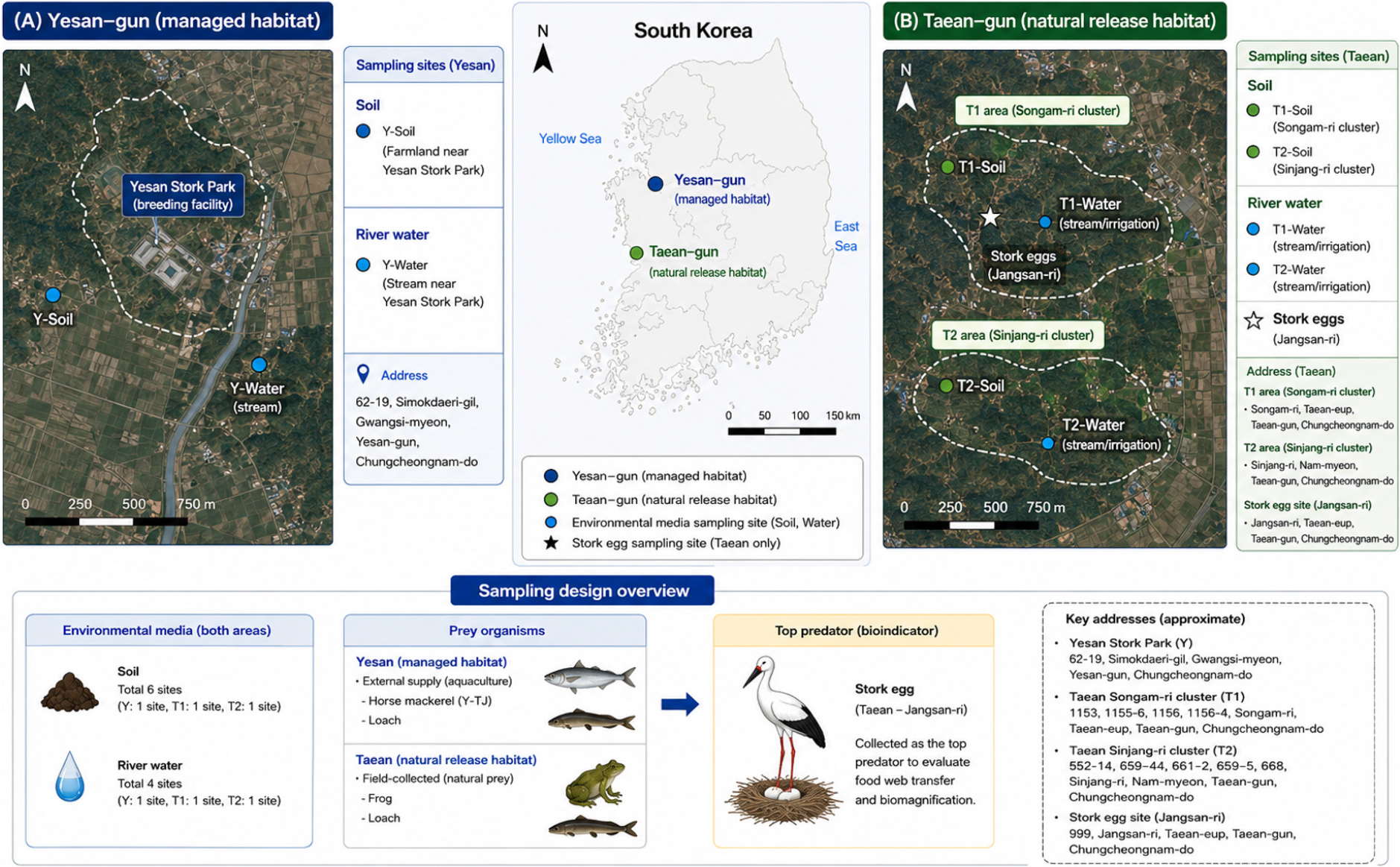
Sample collection was conducted in agricultural wetland ecosystems surrounding oriental stork (Ciconia boyciana) habitats in Yesan and Taean, Chungcheongnam-do, Korea. Although both regions are characterized by the coexistence of agricultural activities and wetland environments, they differ in stork habitat types and prey utilization structure.
Yesan County is an inland agricultural area where a managed oriental stork restoration system is operated around the Yesan Stork Park (YEHWANG, 2025). Storks in the Yesan region are maintained under a managed environment based on captive breeding facilities within the park, and some prey organisms are supplied through external feeding systems. Therefore, the Yesan region reflects exposure characteristics associated with restricted movement ranges and managed feeding structures.
Sample collection in the Yesan region was conducted around stork activity areas within the Yesan Stork Park and adjacent agricultural environments. Soil samples were collected from areas surrounding breeding facilities and nearby water tanks where stork activities frequently occurred, while stream water samples were obtained from aquatic systems adjacent to the park. Prey organism samples included externally supplied horse mackerel and cultured loaches provided at the Yesan Stork Park.
In contrast, Taean County represents a natural-based ecological environment where agricultural lands and coastal wetlands are interconnected, and where oriental storks restored and managed at the Yesan Stork Park have been naturally released. Storks in the Taean region utilize natural prey organisms such as fish, amphibians, and benthic organisms within natural ecosystems after release. Accordingly, the Taean region reflects environmental conditions associated with natural food-web-based exposure characteristics.
Sample collection in the Taean region was conducted around major activity ranges of released storks and adjacent agricultural and wetland environments. Soil samples were collected from agricultural fields and surrounding open areas near Solago CC, while stream water samples were collected from nearby small streams and agricultural irrigation channels. Prey organism samples consisted of frogs and loaches collected from natural habitats.
In this study, the Yesan region, representing a managed feeding environment, and the Taean region, representing a natural food-web-based environment, were compared to evaluate contaminant distribution and food-web transfer characteristics within agricultural wetland ecosystems. The study areas, sampling locations, and food-web-based sample composition are presented in Fig. 1.
Sample collection
Samples were collected using the same sampling framework employed in a previous study conducted in the same regions (Lee et al., 2026). The collected samples were classified into environmental matrix samples and biological samples. Environmental matrix samples included soil and stream water, whereas biological samples included stork eggs, prey organisms, regurgitated materials, and feathers.
Soil samples were collected from surface soils (0 - 10 cm depth) in stork activity areas and adjacent agricultural environments in each region. Stream water samples were collected from nearby streams and agricultural irrigation channels. All environmental samples were stored in sealed containers immediately after collection and transported to the laboratory under refrigerated conditions. Prey organism samples were selected to reflect regional feeding characteristics. In the Yesan region, offshore-caught horse mackerel supplied by external vendors and cultured loaches provided at Yesan Stork Park were used. In the Taean region, frogs and loaches were collected directly from natural habitats.
Stork egg samples consisted of infertile and abandoned eggs collected from nests in the Yesan and Taean regions. In addition, regurgitated materials collected from breeding facilities within the Yesan Stork Park and naturally shed feathers were collected and analyzed to provide supplementary information for evaluating food-web transfer characteristics. Stork egg samples obtained in the previous study were reused in the present study, whereas additional environmental and prey organism samples were collected to expand the dataset. Replicate analyses were performed for each sample group to compare detection characteristics among sample types. The numbers of environmental, prey organism, and stork egg samples were each composed of 12 samples, while feather and regurgitated material samples consisted of three samples each. Based on the previous study, which included approximately five samples per sample group, the present study increased the number of replicate samples to improve the reliability of detection characteristic comparisons.
All collected samples were stored under refrigerated or frozen conditions until analysis. Prior to analysis, samples were homogenized and subsequently subjected to sample preparation and instrumental analysis. Table 1 summarizes the characteristics and roles of the collected sample groups used in this study, including regional classification and sample-specific features.
Table 1.
Summary of sample groups and sampling design used in this study.
Target compounds
Based on the results of a previous screening study, pesticide compounds showing detectable occurrence characteristics were selected as the final target analytes. The screening results indicated the occurrence of DDT related compounds in stork eggs and several biological samples, whereas fipronil-related compounds were detected in some environmental and natural prey organism samples.
Accordingly, DDT and its metabolites, including p,p′-dichlorodiphenyltrichloroethane (p,p′-DDT), o,p′-dichlorodiphenyltrichloroethane (o,p′-DDT), p,p′-dichlorodiphenyldichloroethylene (p,p′-DDE), and p,p′-dichlorodiphenyldichloroethane (p,p′-DDD), together with fipronil and its major metabolite, fipronil sulfone, were selected as the final target compounds in this study. The selected compounds were used to compare occurrence characteristics and food-web-based transfer patterns among environmental matrices, prey organisms, and stork-related samples within agricultural wetland ecosystems.
Standards and reagents
Analytical standards for p,p′-DDT, o,p′-DDT, p,p′-DDE, p,p′-DDD, fipronil, and fipronil sulfone were purchased from AccuStandard Inc. (New Haven, CT, USA), and all standards used in this study had purities greater than 97%. Acetonitrile and methanol used for sample preparation and instrumental analysis were of LC-MS grade or higher, while all other reagents were of analytical grade or higher. Ultrapure water was produced using a purification system with a resistivity of at least 18 MΩ·cm.
All laboratory glassware and experimental equipment were rinsed with ultrapure water and organic solvents prior to use to minimize cross-contamination among samples.
Sample preparation and instrumental analysis
Sample preparation procedures were performed according to sample characteristics. Soil samples were air-dried and homogenized prior to analysis, while stream water samples were mixed thoroughly before analysis. Biological samples were homogenized prior to sample preparation. Sample preparation for pesticide residue analysis was conducted using a QuEChERS-based method (Anastassiades et al., 2003), followed by dispersive solid-phase extraction (d-SPE) cleanup depending on matrix characteristics. For high-lipid biological samples, an additional freezing-out step was applied to minimize matrix interference (Lehotay et al., 2005). DDT-related compounds were analyzed using GC-MS/MS (Shimadzu Q8050NX, Japan), whereas fipronil and fipronil sulfone were analyzed using LC-MS/MS (Waters TQ-XS, USA). All compounds were analyzed in multiple reaction monitoring (MRM) mode. Instrumental conditions and sample preparation procedures were based on previously validated methods reported in an earlier study (Lee et al., 2026).
Statistical analysis
The occurrence characteristics of pesticide residues in environmental matrices and biological samples were compared based on detection frequency and concentration ranges. Descriptive statistical analyses were performed to evaluate occurrence characteristics according to region and sample type, and the mean and standard deviation were calculated (Helsel, 2012).
For fipronil sulfone, one-way analysis of variance (ANOVA) was conducted to compare concentration differences among sample groups (Zar, 2010). Statistical analyses were performed using SPSS software (IBM, 2023), and statistical significance was set at p < 0.05. In contrast, p,p′-DDE was not detected in most environmental samples and was only detected in limited biological samples, which restricted the application of statistical comparisons.
To evaluate food-web-based transfer characteristics, the biomagnification factor (BMF) for p,p′-DDE was calculated. The BMF was determined by dividing the concentration in the upper trophic-level organism by the concentration in its prey organism (Borgå et al., 2012).
where represents the concentration detected in stork eggs as the upper trophic-level predator, whereas represents the concentration detected in prey organisms. A BMF value greater than 1 was interpreted as indicating the potential for biomagnification in higher trophic levels (Borgå et al., 2012).
In addition, occurrence characteristics between environmental matrices and biological samples were comprehensively compared to evaluate the environmental distribution and food-web transfer patterns of contaminants.
Results
Environmental occurrence in environmental matrices
The results of pesticide residue analysis in environmental matrix samples are presented in Table 2. Among the target compounds, p,p′-DDE was not detected in any soil or stream water samples collected from the Yesan and Taean regions. In contrast, fipronil sulfone was detected only in soil samples from the Taean region (T1-Soil and T2-Soil), with mean concentrations of 0.009 mg/kg and 0.003 mg/kg, respectively.
Neither p,p′-DDE nor fipronil sulfone was detected in stream water samples. In addition, both compounds were not detected in environmental matrix samples collected from the Yesan region. Comparison of occurrence characteristics among sample groups showed that fipronil sulfone was detected only in soil samples from the Taean region, whereas p,p′-DDE was not detected in any environmental matrix samples. Table 2 summarizes the occurrence characteristics of pesticide residues in environmental matrices from the Yesan and Taean regions.
Table 2.
Detection characteristics of residual pesticides in environmental matrices from Yesan and Taean regions.
Detection characteristics in prey organisms and stork-related samples
The analysis of pesticide residue concentrations in stork eggs and prey organism samples revealed different occurrence patterns among the target compounds. p,p′-DDE was detected in stork eggs and externally supplied prey organisms, specifically horse mackerel. The mean concentrations of p,p′-DDE in stork egg samples were 0.023 ± 0.012 mg/kg for Y-Egg and 0.065 ± 0.061 mg/kg for T-Egg. In horse mackerel samples (Y-TJ), the mean concentration was 0.002 ± 0.001 mg/kg.
In contrast, fipronil sulfone was detected in naturally collected prey organisms, including frogs and loaches, but was not detected in stork eggs or externally supplied prey organisms such as horse mackerel and cultured loach. The mean concentrations in frog samples were 0.022 ± 0.015 mg/kg for T1-Frog and 0.036 ± 0.050 mg/kg for T2-Frog, whereas naturally collected loach samples showed concentrations of 0.006 ± 0.002 mg/kg for T1-Loach and 0.008 ± 0.002 mg/kg for T2-Loach.
In addition, p,p′-DDE was detected in stork feather and regurgitated material samples collected from breeding facilities at the Yesan Stork Park, with mean concentrations of 0.004 ± 0.002 mg/kg and 0.009 ± 0.004 mg/kg, respectively. However, these samples were analyzed using a limited sample size (n = 3) and were therefore used as supplementary data for confirming occurrence characteristics. The pesticide residue analysis results for prey organisms and stork-related samples are presented in Table 3, while food-web-based exposure structures and occurrence characteristics among sample groups are illustrated in Fig. 2.
Table 3.
Detection characteristics of p,p′-DDE and fipronil sulfone in prey organisms and stork-related samples.

Statistical comparison of fipronil sulfone concentrations
One-way ANOVA was performed to compare differences in fipronil sulfone concentrations among sample groups, and the results are presented in Table 4. The analysis showed statistically significant differences in fipronil sulfone concentrations among the sample groups (F = 3.98, p = 0.007). Fipronil sulfone was detected in soil samples and naturally collected prey organisms from the Taean region, with relatively higher concentration ranges observed in frog samples. In contrast, p,p′-DDE was not detected in most environmental and natural prey organism samples, which limited the application of statistical comparisons among sample groups. In addition, because several sample groups showed high proportions of non-detected (ND) values, the statistical results were used as supplementary interpretative data.
Table 4.
Results of one-way ANOVA for fipronil sulfone concentrations among sample groups.
| Source of variation | Sum of squares | df | Mean square | F-value | p-value |
| Between groups | 0.0087 | 4 | 0.0022 | 3.98 | 0.007 |
| Within groups | 0.0301 | 55 | 0.0005 | - | - |
| Total | 0.0389 | 59 | - | - | - |
Food-web transfer and biomagnification factor (BMF)
p,p′-DDE was detected in both externally supplied prey organisms, specifically horse mackerel (Y-TJ), and stork egg samples (T-Egg and Y-Egg). In addition, p,p′-DDE was also detected in feather and regurgitated material samples, indicating the potential for continuous exposure within the stork population. In contrast, fipronil sulfone was detected in naturally collected prey organisms but was not detected in stork-related samples.
In this study, horse mackerel (Y-TJ), which showed detectable concentrations within the same food web as the stork eggs, was used as the reference prey organism for calculating the BMF of p,p′-DDE. The calculated BMF values for p,p′-DDE were 11.35 for T-Egg and 32.60 for Y-Egg, while the average BMF value based on the mean concentration of stork eggs was 22.00.
In contrast, fipronil sulfone was not detected in stork-related samples, making it difficult to confirm transfer characteristics to upper trophic levels; therefore, BMF values were not calculated for this compound.
The food-web transfer characteristics and BMF results between stork-related samples and prey organism samples are presented in Table 5 and Fig. 3.
Table 5.
Biomagnification factor (BMF) of p,p′-DDE between prey organisms and stork eggs.

Fig. 3.
Schematic illustration of differential trophic transfer patterns of p,p′-dichlorodiphenyldichloroethylene (p,p′-DDE) and fipronil sulfone in the oriental stork food web. The figure illustrates detection patterns and potential trophic associations of p,p′-DDE and fipronil sulfone based on the present study results. p,p′-DDE was detected in horse mackerel and stork-related samples, whereas fipronil sulfone was detected mainly in soil and lower trophic prey organisms. The proposed pathways do not confirm direct dietary sources or actual trophic transfer routes.
Discussion
Differential environmental distribution of DDT and fipronil sulfone
In this study, different food-web transfer characteristics of p,p′-DDE and fipronil sulfone were identified in oriental stork populations that had been restored and raised at the Yesan Stork Park and subsequently released into natural environments. p,p′-DDE was not detected in environmental samples such as soil and stream water; however, it was detected in externally supplied prey organisms, including horse mackerel (Trachurus japonicus), as well as in stork eggs, feathers, and regurgitated material samples. In contrast, fipronil sulfone was detected in soil and naturally collected prey organisms from the Taean region but was not detected in stork-related samples. DDT-related compounds are representative POPs known for their strong lipophilicity and environmental persistence (Turusov et al., 2002). p,p′-DDE, a major metabolite of DDT, has been reported to possess high bioaccumulation potential and the ability to transfer to higher trophic levels (Kelly et al., 2007). In the present study, p,p′-DDE exhibited occurrence patterns primarily in biological samples rather than environmental matrices, and the high BMF values were interpreted as reflecting the potential for food-web-based accumulation. In particular, p,p′-DDE was detected in both externally supplied horse mackerel from the Yesan region and stork eggs collected from the Yesan and Taean regions. Horse mackerel is a marine fish species known to accumulate POPs within marine food webs (Storelli et al., 2008), and DDT-related compounds have been consistently reported in marine ecosystems (Moon et al., 2007).
However, the present study did not directly evaluate the long-term distribution history or origin-related contamination characteristics of externally supplied prey items, limiting the interpretation of the exact contamination source.
In contrast, fipronil sulfone was detected in soils and naturally collected prey organisms but was not detected in stork eggs. Fipronil is an insecticide widely used in rice cultivation and can be transformed into fipronil sulfone through oxidative processes in paddy soils. Previous studies have reported that fipronil sulfone may be transported to paddy water and adjacent aquatic environments, resulting in the exposure of aquatic invertebrates and amphibian larvae (Tingle et al., 2003; Gunasekara et al., 2007; Kumar et al., 2013).
Fipronil sulfone is recognized as the major oxidative metabolite of fipronil and is one of the predominant degradation products formed in various environmental matrices, including plants and soils (Kumar et al., 2013). Therefore, the occurrence of fipronil sulfone in soils and naturally collected prey organisms from the Taean area may be associated with environmental transformation following historical or ongoing use of fipronil in agricultural settings.
Furthermore, because fipronil sulfone may exhibit greater toxicity than the parent compound in certain aquatic organisms, it should be considered an important target compound in ecological risk assessments (Schlenk et al., 2001; Weston and Lydy, 2014).
The relatively high concentrations observed in frog samples in the present study suggest that amphibians may respond sensitively to agricultural fipronil exposure and may act as potential indicators of contamination and food-web-based exposure in agricultural wetland ecosystems. These characteristics may also be associated with indirect exposure through prey organisms within agricultural environments. Consistent with this interpretation, fipronil sulfone was detected in soil and naturally collected prey organisms from the Taean region, reflecting possible exposure originating from agricultural environments.
However, the absence of fipronil sulfone in stork eggs indicates that transfer to upper trophic levels was limited within the scope of this study. These findings suggest that contaminants may exhibit different trophic transfer patterns depending on their physicochemical properties and metabolic behaviors. In particular, fipronil sulfone may be detectable in environmental matrices and lower trophic organisms but may show reduced accumulation potential at higher trophic levels because of metabolic transformation or excretion processes (Gobas et al., 2009).
Furthermore, because pesticide application histories and prey-source contamination pathways were not directly investigated, additional studies are required to clarify the specific contamination sources and food-web transfer mechanisms.
The Yesan region represents a managed restoration environment based on captive breeding facilities within the Yesan Stork Park, where some prey organisms are supplied externally.
In contrast, the Taean region represents a natural food-web-based environment in which restored and released storks inhabit agricultural lands and wetland ecosystems under natural conditions. Accordingly, this study provides an opportunity to compare exposure characteristics of the same restored stork population under managed feeding conditions and natural food-web environments. In addition, p,p′-DDE was not detected in most environmental samples and was only detected in limited biological samples, restricting the application of statistical comparisons. Conversely, fipronil sulfone showed relatively consistent occurrence patterns in soil and naturally collected prey organism samples, allowing limited statistical analysis. These differences may also be associated with differences in environmental persistence and bioaccumulation potential between the compounds. DDT-related compounds are known to possess long environmental half-lives and high lipophilicity, resulting in strong bioaccumulation and food-web-based biomagnification potential (Turusov et al., 2002; Kelly et al., 2007). In contrast, although fipronil sulfone showed evidence of environmental exposure, it exhibited relatively limited bioaccumulation characteristics, and because it was not detected in any stork-related samples, BMF values were not calculated for this compound.
Ecological implications of pesticide persistence in agricultural wetland ecosystems
Agricultural wetland ecosystems form complex environmental structures in which agricultural lands, aquatic systems, and diverse biological communities are interconnected, allowing contaminants to be transferred and accumulated through food webs to upper trophic levels. In the present study, both managed restoration environments and post-release natural habitats were evaluated using the same restored oriental stork population to investigate long-term ecological exposure characteristics of contaminants within agricultural wetland ecosystems.
Although p,p′-DDE was not detected in environmental matrix samples, it was continuously detected in prey organisms and stork-related samples. These findings indicate that even banned persistent contaminants may remain within ecosystems for extended periods and persist in biologically accumulated forms. In particular, the high BMF values observed in stork eggs reflect the potential for biomagnification at upper trophic levels and may be associated with long-term ecological exposure in agricultural wetland ecosystems.
In contrast, fipronil sulfone was detected in soils and lower trophic prey organisms within natural agricultural environments but was not detected in stork-related samples. These findings suggest that although contaminants derived from currently used pesticides may occur in agricultural environments, their transfer to upper trophic levels may be limited. In addition, the occurrence patterns observed in naturally collected prey organisms appear to reflect exposure originating from agricultural environments.
The oriental stork (Ciconia boyciana), as an upper trophic predator inhabiting agricultural wetland ecosystems, has high potential as a bioindicator species for reflecting environmental changes and contaminant exposure characteristics. The combined use of stork eggs, feathers, and regurgitated material samples demonstrates the applicability of integrated ecological risk assessment approach based on upper trophic predators.
Overall, p,p′-DDE and fipronil sulfone detected in this study exhibited different environmental distribution and food-web-based occurrence characteristics. However, because this study was conducted using a limited number of prey organism samples, there are limitations in representing the entire food web utilized by oriental storks. Nevertheless, the integrated approach incorporating environmental matrices, prey organisms, and upper trophic predators may provide useful information for evaluating long-term ecological exposure characteristics of persistent contaminants in agricultural wetland ecosystems.
Conclusion
This study evaluated the environmental distribution and food-web-based occurrence characteristics of p,p′-DDE and fipronil sulfone in agricultural wetland ecosystems surrounding oriental stork habitats in Yesan and Taean, Chungcheongnam-do, Korea.
The results showed that p,p′-DDE was not detected in environmental matrices such as soil and stream water but was detected in externally supplied prey organisms, including marine-caught horse mackerel, as well as in stork eggs, feathers, and regurgitated material samples.
In particular, high BMF values observed in stork eggs suggested the potential for biomagnification at upper trophic levels. In contrast, fipronil sulfone was detected in soil and naturally collected prey organism samples from the Taean region but was not detected in stork-related samples. Evaluation of the same restored stork population under managed feeding environments and natural food-web environments demonstrated different occurrence and food-web distribution characteristics between p,p′-DDE and fipronil sulfone. p,p′-DDE was mainly detected in biological samples, whereas fipronil sulfone was primarily detected in environmental matrices and lower trophic prey organisms, indicating limited transfer to upper trophic levels. Notably, p,p′-DDE was detected in stork eggs, feathers, regurgitated materials, and horse mackerel despite its absence in most environmental samples, suggesting that persistent contaminants may remain in biological samples for long periods or may occur through prey-source-based exposure pathways. However, although the detection in externally supplied horse mackerel suggests the possibility of prey-source-related exposure, the present study did not directly evaluate prey-source histories or contamination origins, limiting the interpretation of specific transfer pathways.
Therefore, evaluation of persistent contaminants in agricultural wetland ecosystems requires an integrated approach that includes prey organisms and upper trophic predators in addition to environmental matrix analyses. Upper trophic predators such as oriental storks may serve as important bioindicator species for assessing long-term ecological exposure characteristics. Future studies should further investigate prey-source histories and contamination origins to clarify specific transfer pathways in greater detail.