
Plant & Forest

Korean Journal of Agricultural Science. 1 March 2024. 9-23
https://doi.org/10.7744/kjoas.510102

ABSTRACT


MAIN

  • Introduction

  • Materials and Methods

  •   연구 대상자

  •   연구 대상지

  •   자연기반 아웃도어활동 프로그램의 설계

  •   자연기반 아웃도어 활동 프로그램의 구성

  •   생리적 측정지표

  •   심리적 측정지표

  •   자료 분석

  • Results and Discussion

  •   생리적 측정지표

  •   심리적 측정지표

  • Conclusion

Introduction

기술 발달과 사회 복잡성 증가로 인류는 더욱 풍요로운 삶을 누리고 있지만, 그만큼 삶의 질을 위협하는 사회적 재난과 위험도 빠르게 증가하고 있다. 경제, 산업 분야의 발전 과정에서 화재, 시설물 붕괴, 폭발, 안전사고의 증가와 더불어 기후변화로 인한 홍수, 산사태, 침수, 산불 등 자연재해와 코로나19와 같은 팬데믹까지 재난의 형태도 다양해지고 있다. 소방청 자료를 보면 2017년부터 5년 동안 화재는 총 20만 1,545건이 발생하고, 이에 따라 1,640명이 사망하고 1만 79명이 다쳤다(NFA, 2022). 2022년 3월 1만 6,302 ㏊의 산림이 소실된 울진·삼척 산불은 초대형 광역 산불로 전국 소방동원령 2호가 발령되면서 소방관 등 산불진화대원 1만 6,000여명이 보름에 걸쳐 화마와 사투를 벌였다. 이어 같은 해 10월 말 사망 159명, 부상 197명이 발생한 이태원 참사는 전국민적 트라우마를 안겼다.

우리는 수많은 위험에 노출되어 살아가고 있으며, 이처럼 재난의 범위가 확대되고 증가함에 따라 사람들은 여러 차원에서 고통에 시달리고 있다. 재난에 노출된 사람들은 크고 작은 충격을 경험하게 되는데, 이때 심각한 육체적‧정신적 피해를 가져오는 충격적 사건 또는 사고를 외상(trauma)이라고 정의한다(Lee and Hah, 2012). 아울러 이 같은 외상을 겪은 대상자가 극심한 스트레스를 경험할 때 이를 적절히 대처하지 않으면 다양한 문제가 발생할 수 있는데, 대표적 질환이 외상 후 스트레스 장애(post-traumatic stress disorder, PTSD)다. 다양한 재난과 범죄 사건의 직접적인 피해자뿐 아니라 그 현장에 투입되어 외상에 반복적으로 노출되는 소방공무원, 경찰관, 군인, 응급의료 종사자 등의 직업군은 PTSD로 발현되기 쉬운 고위험 직업군에 해당한다(Park, 2014; Kim et al., 2015). 특히, 직무 특성 상 재난 현장의 최일선에 투입되어 화재를 진압하고 위급 상황에서 구조, 구급 활동을 하는 소방공무원은 업무 수행 과정에서 본인도 부상을 경험하거나 생명을 위협받는 등 각종 위험에 노출된다(Yoon and Yoon, 2022).

대한민국 전체 소방공무원은 6만 4,768명이 재직중이며, 사회가 복잡하고 다변화됨에 따라 소방공무원의 역할이 확대되어 화재 예방, 경계 및 진압 외에도 벌집 제거 등의 생활안전과 태풍, 홍수, 호우 등의 자연 재난, 화재, 붕괴, 폭발 등의 사회재난, 그리고 위급 상황에서 인명구조, 구급 활동을 수행하며 국민 생활 전반에 걸쳐 생명과 안전을 책임지고 있다(NFA, 2022). 소방공무원의 구조 및 119구급 출동 건수는 매년 증가하여, 2021년 구조 출동 건수는 106만 2,612건으로 5년 전인 2016년에 비해 30만 5,625건 늘었고, 119구급 출동 건수는 2021년 314만 8,965건 으로 5년 사이에 47만 1,207건 증가했다(NFA, 2022). 소방공무원은 다른 직종보다 다양한 위험에 노출되는 외상 경험이 높아 51%가 보직 이동을 원하거나, 16.8%는 이직을 생각하는데, 27.5%는 열악한 근무 환경을 이유로 꼽았다(Kim and Kwon, 2002). 소방청에서 실시한 ʻ2022년 소방공무원 마음 건강 전수 조사’에서도 외상 후 스트레스 장애, 우울증, 수면장애 등에 대한 고위험군 비율이 유의미한 증가세(2 - 7%)를 나타냈는데, 특히 자살 고위험군의 경우 2,906명(5.4%)으로 전년 대비(2,390명, 4.4%) 1%P 증가하였다(NFA, 2022).

이 같이 소방공무원을 대상으로 수행된 연구들은 소방공무원의 외상 후 스트레스 저감(Baek, 2009; Lee and Hah, 2012; Kim and Jeong, 2020), 직무스트레스 저감(Kim et al., 2006; Lee and Kim, 2016; Kim, 2019), 우울증 감소(Park et al., 2022), 삶의 질과 직무만족도 향상(Choi et al., 2016; Rho, 2020) 등이 보고되고 있다. 연구에서 사용된 프로그램은 음악치료(Baek and Kim, 2016), 집단예술치료(Paik and Choi, 2017), 명상기반 힐링프로그램(Kim et al., 2019), 통합예술치료(Lee and Park, 2020), 정신건강교육(Hur et al., 2020), 아트테라피(Yoon and Yoon, 2022) 등이 있었다. 위의 프로그램들이 주로 실내에서 이루어진 반면, 최근에는 야외에서 자연을 매개로 하는 산림치유, 해양치유, 치유농업과 같은 여러 치유 방법이 또한 관심을 받고 있다.

다양한 연구를 통해 산림을 구성하는 요소와 숲에서의 활동이 인체를 안정시키고(Joung et al., 2013; Park et al., 2014; Song et al, 2015) 스트레스를 낮추며(Lee and Lee, 2012; Park et al., 2017) 면역력 향상에 기여한다(Li, 2010; Yoo et al., 2011; Chae et al., 2021)는 사실이 밝혀지고 있다. 이에 따라, 건강하고 활력 있는 삶을 영위하기 위한 주요 수단으로 산림치유가 주목받고 있고, 소방공무원을 대상으로 한 산림치유프로그램이 외상 후 스트레스 감소와 기분 상태 개선에 효과가 있고(Park et al., 2019) 정서적 회복에 도움이 되었다(Park, 2021)는 선행연구도 있다.

또한, 해양의 기후와 경관, 해풍, 해양환경뿐 아니라 해수, 모래, 해조류 등 해양자원을 활용하여 건강증진 활동을 하는 해양치유(Lee et al., 2020c) 분야에서도 해안의 푸른 공간에 더 많이 노출될수록 우울증에 걸릴 확률이 낮아지며(Dempsey et al., 2018) 해양치유 힐링 체험 후 우울감이 완화되었다(Choi et al., 2022)는 보고가 있다. 또한, 피험자들의 수면의 질과 기분상태가 호전되었으며 인지기능이 향상되었다(Lee et al., 2018b)는 연구도 있다.

그러나, 산림환경과 해양환경을 복합적으로 사용한 연구는 보고된 바 없다. 이러한 배경으로 본 연구에서는 산림과 해안지역의 특성을 결합하여 설계된 자연기반 아웃도어 활동 프로그램이 소방공무원들에 생리·심리적으로 미치는 효과를 알아보고자 한다.

Materials and Methods

연구 대상자

본 연구는 ʻ국립공원 힐링 캠프’의 일환으로 진행되었으며, 남성 소방공무원 30명(평균 나이: 40.4 ± 9.8세)이 참여하였다. 피험자는 연구에 참여하기 전에 연구의 내용에 대한 충분한 설명과 정보를 제공받았으며, 연구 방법을 숙지한 뒤 연구의 참여에 동의한다는 동의서를 작성하였다. 본 연구는 헬싱키 선언(Declaration of Helsinki)에 근거한 윤리적 원칙과 지침에 따라 진행되었으며, 모든 실험적 절차는 충남대학교 생명윤리심사위원회의 심의(IRB No. 202107-SB-172-01)를 거쳐 수행되었다.

연구 대상지

본 연구는 경상남도 통영시에 있는 한려해상생태탐방원에서 진행되었다. 한려해상생태탐방원은 1968년 우리나라에서 2번째이자 해상공원으로는 최초로 국립공원으로 지정된 한려해상국립공원에 속해 있으며, 국립공원에서 생태관광프로그램 운영을 위해 설치한 시설로써 주변의 우수한 생태·문화·자원 등을 활용하여 자연생태와 환경에 대한 교육과 체험을 하는 생태관광의 거점 시설로 활용되고 있다. 특히, 주변에는 완만한 경사의 산지대가 있어 산림자원 또한 풍부하다. 한려해상국립공원 지역은 해송과 소나무 우점군락이 보고되고 있고, 편백식재림, 삼나무식재림 등이 기재되고 있는데(Kim et al., 2000; Choi et al., 2015) 본 연구에서도 편백숲에서 프로그램을 진행하였다. 탐방원은 리아스식 해안에 위치하여 육지 쪽으로 오목하게 들어간 ʻ만’과 바다 쪽으로 돌출된 ʻ반도’ 그리고 섬들을 조망할 수 있어서 주변 경관이 수려하다(Fig. 1). 생태관광 수요가 증가하면서 그에 대비한 기반 시설을 확충하고 지역사회에 생태교육 기능을 강화할 필요성이 대두되면서 자연 체험형 탐방서비스를 제공하고 있다.

이렇듯 산림과 해안지역의 특성을 반영하여 자연기반 아웃도어 활동 프로그램을 진행하기에 적합한 환경을 갖추고 있는 한려해상생태탐방원은 2018년 10월 개원한 이래 총 33,000명의 탐방객이 생태탐방에 참여하였다(TBS, 2023).
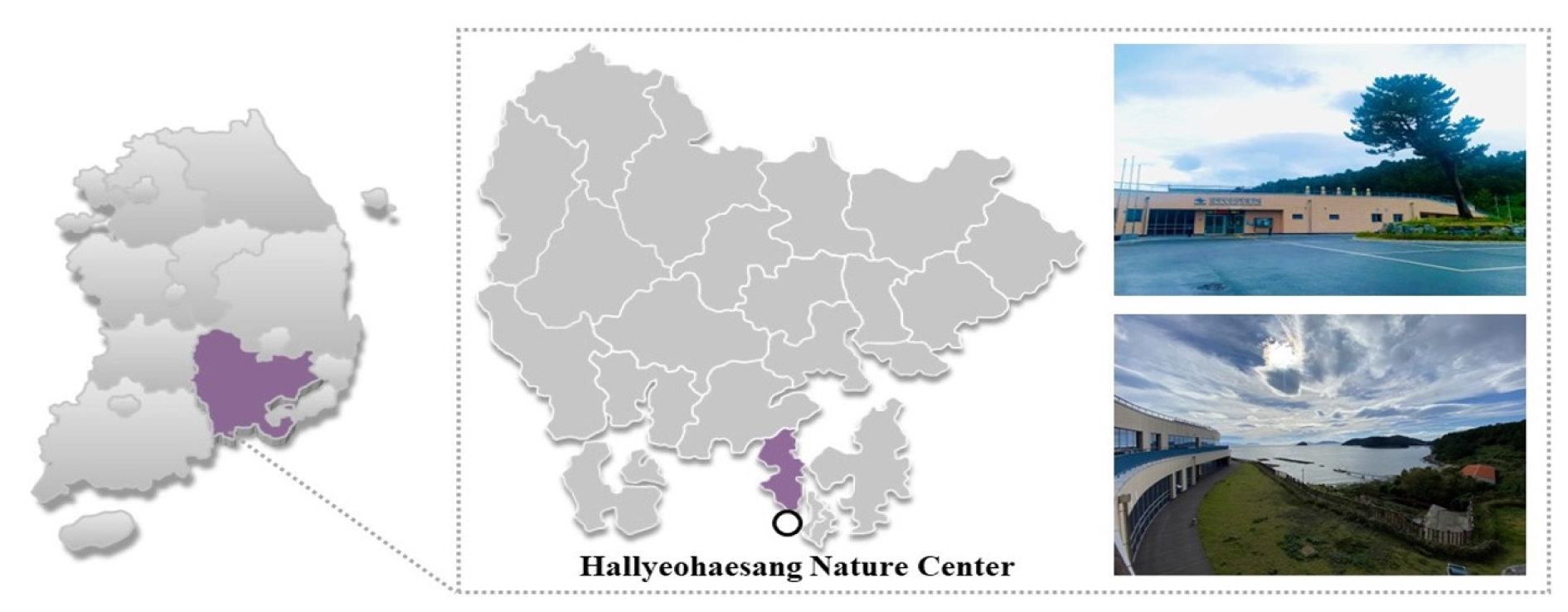
https://cdn.apub.kr/journalsite/sites/kjoas/2024-051-01/N0030510102/images/kjoas_2024_511_9_F1.jpg
Fig. 1.

Maps and scenery of Hallyeohaesang Nature Center.

자연기반 아웃도어활동 프로그램의 설계

연구 절차

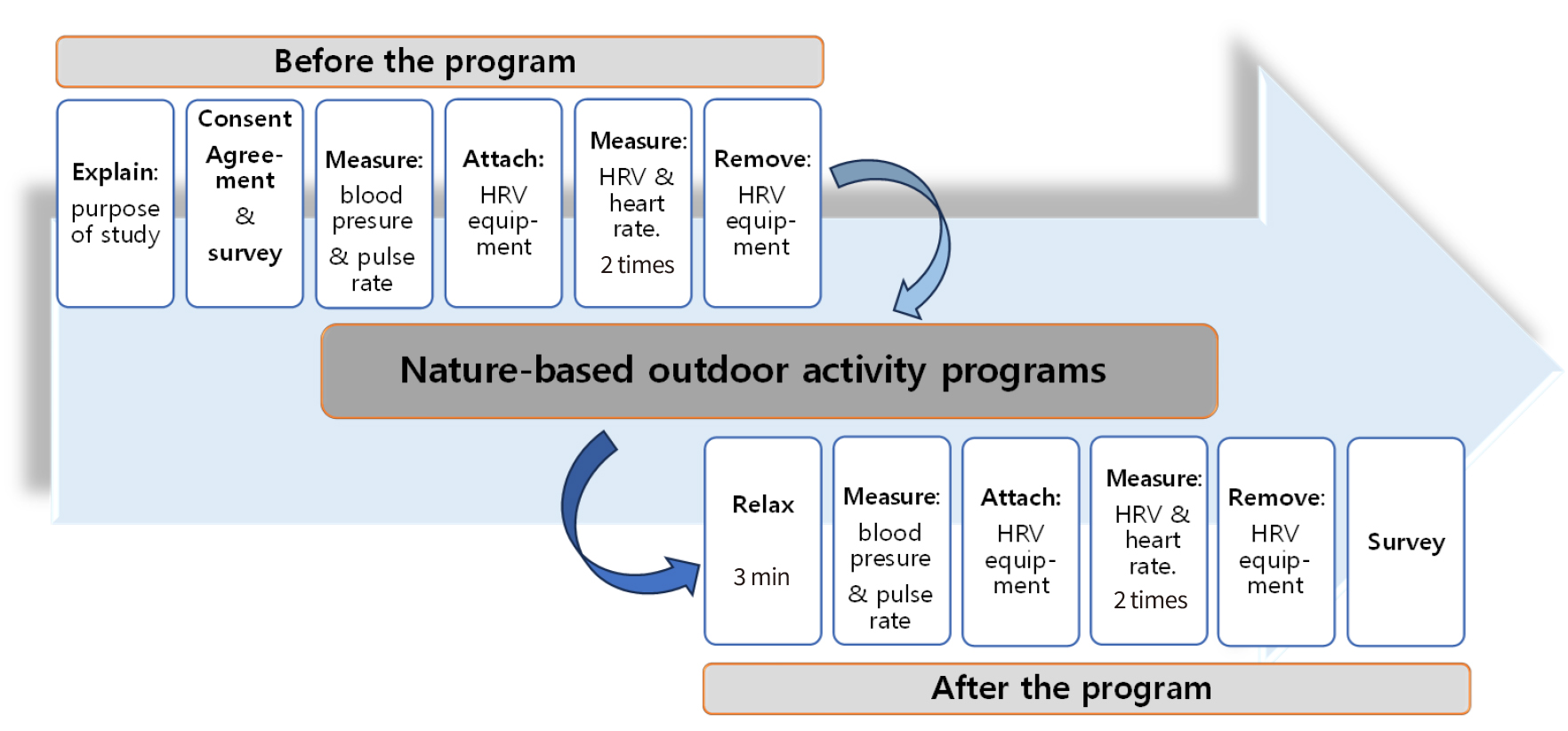
본 연구는 2022년 10월 4일부터 10월 7일까지 3박 4일 동안 진행되었고, 프로그램의 효과성 검증은 참여한 집단의 사전-사후 결과 비교분석을 통해 이루어졌다. 사전 측정은 프로그램의 첫날 진행되었으며, 사후 측정은 프로그램 마지막 날에 진행되었다. 프로그램 참여 전과 후의 생리적 변화를 조사하기 위하여 혈압, 맥박, 심박변이도를 측정하였고, 심리적 변화를 조사하기 위하여 한국판 정적정서 부적정서 척도(positive affect and negative affect schedule, PANAS), 한국판 Warwick-Edinburgh mental well-being scale (WEMWBS), 한국판 회복환경지각척도(perceived restorativeness scale, PRS)를 사용하였다(Fig. 2).
https://cdn.apub.kr/journalsite/sites/kjoas/2024-051-01/N0030510102/images/kjoas_2024_511_9_F2.jpg
Fig. 2.

Procedure of the experiment. HRV, heart rate variability.

자연기반 아웃도어 활동 프로그램의 구성

본 자연기반 아웃도어 활동 프로그램은 숲이 가지고 있는 다양한 치유 인자를 활용하여 생리·심리적 안정에 도움이 되는 산림치유프로그램과 해양 환경에서 할 수 있는 아웃도어 활동으로 구성되었다(Table 1).

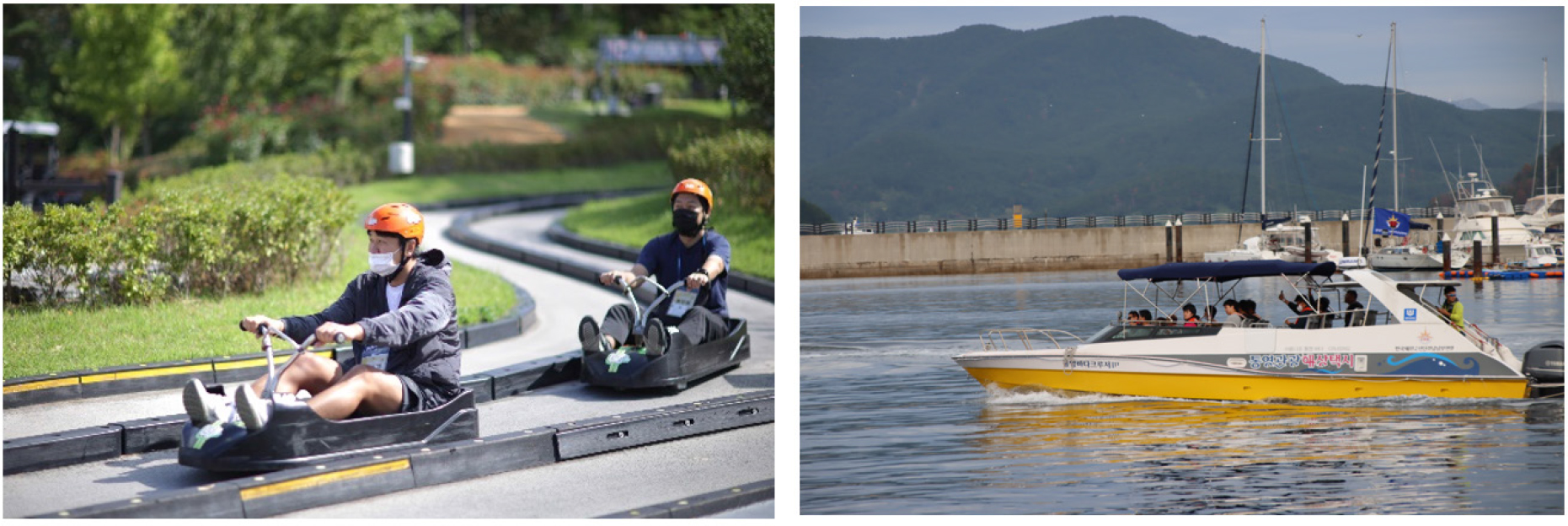
산림자원을 활용한 야외활동으로는 탐방원 인근의 편백 숲에서 맨발 걷기, 아로마 족욕, 숲속 산소 돔에서 앉아 명상하기, 이완 의자에 누워 호흡하기 등을 하였고 만지도·연지도 숲길 트레킹을 진행하였다. 해양자원을 활용한 프로그램으로 주변이 바다로 둘러싸인 생태원 내·외부에서 팀워크를 다지는 오리엔티어링, 통영에서 스카이라인 루지 경험을 했다. 또한, 통영 앞 바다에서 요트를 타고, 섬에서의 숲길 트레킹을 하기 위해 배를 타고 섬으로 들어가 탁 트인 바다 경관을 바라보며 숲길을 걸었다(Fig. 3).

Table 1.

Schedule of the natured-based outdoor activity program.
Date Time Main contents Specific contents
Day 1
(10/4)
14:00 - 14:30 Explain & sign Explain the purpose of the experiment
Sign a consent form
Measurement & survey Measuring blood presure, pulse rate, and HRV
PANAS, WEMWBS, PRS
14:30 - 15:00 Orientation Introduction and greeting
15:00 - 18:00 Team orienteering Various activities for team building inside and outside the nature center
Day 2
(10/5)
10:00 - 12:00 Skyline luge Luge experience on the grass near the sea
13:30 - 16:30 Manjido trekking Move to Manjido island by boat
Hiking in the forest with the ocean view
Day 3
(10/6)
10:00 - 12:00 Healing in the forest Walking in the forest
Walking barefoot
Sitting in an oxygen dome
Lying and relaxing on the long chair
Aroma foot bath
13:00 - 18:00 Hansando yachting Sailing on the sea
19:30 - 21:00 Consert under the stars Enjoying the consert and singing along
Day 4
(10/7)
09:00 - 10:00 Measurement & survey Measuring blood presure, pulse rate, and HRV
PANAS, WEMWBS, PRS
10:00 - 12:00 Recharge for the body and soul Sports massage
Meditation
Program conclusion

HRV, heart rate variability; PANAS, positive affect and negative affect schedule; WEMWBS, Warwick-Edinburgh mental well-being scale; PRS, perceived restorativeness scale.

https://cdn.apub.kr/journalsite/sites/kjoas/2024-051-01/N0030510102/images/kjoas_2024_511_9_F3.jpg
Fig. 3.

Photos of the nature-based outdoor activity program.

생리적 측정지표

혈압

Kannel 등(1971)은 Framingham 연구에서 관동맥 질환의 위험을 예측하면서 나이가 들어감에 따라 확장기 혈압의 중요성이 감소하는 데 반해, 수축기 혈압의 중요성은 증가한다고 보고했다. 수축기 혈압은 연령에 비례하여 계속 증가하는 반면 확장기 혈압은 감소하는 것으로 나타나 확장기 혈압이 더 이상 심혈관질환의 신뢰할 만한 예측변수로 평가될 수 없으며, 수축기 혈압이 심혈관 질환의 위험을 예측할 때 더욱 중요한 인자라는 인식의 변화가 있다(Benetos, 1999). 고혈압의 진단 및 분류에 있어서도 확장기 혈압과 함께 수축기 혈압이 중요하게 취급된다(Park et al., 2004).

맥압(pulse pressure)은 수축기 혈압과 확장기 혈압의 차이 값으로, 수축기 혈압에서 확장기 혈압을 뺀 수치를 말하는데, 맥압이 클수록 혈관 탄력성이 낮고, 혈관 탄력이 낮다는 것은 혈관이 딱딱해져 두꺼워지고 탄력이 저하되었다는 뜻이다(Homan et al., 2018). Franklin 등(2001)은 나이가 듦에 따라 관동맥 위험의 예측인자는 확장기 혈압에서 수축기 혈압을 거쳐 맥압으로 이동한다고 하였다. 본 연구에서는 혈압과 맥박, 맥압을 측정하기 위하여 휴대용 디지털 혈압측정계(ES-P2100, Terumo Corporation, Japan)를 사용하였으며, 사전과 사후에 각각 2회 측정 후 평균값 을사용하였다.

심박변이도(heart rate variability, HRV)

심박변이도는 심장 박동의 R파와 R파 사이의 간격 변화(R-R interval, RRI)를 이용하여 자율신경계의 반응을 측정하는 방법(Kobayashi et al., 1999)이다. 본 연구에서는 휴대용 심전도 모니터 MyBeat (WHS-1, UNION TOOL Co., Ltd., Japan)를 이용하여, 충분한 안정을 취한 후 3분 동안 R파와 R파 사이의 변동을 측정하였다. 또한, RRI 원 데이터의 주파수 분석은 최대엔트로피법(maximum entropy method, Mem; MemCalc/win, GMS Co., Ltd., Japan)을 사 용하였으며, 0.04 - 0.15 Hz의 범위를 저주파 성분(low frequency, LF)으로, 0.15 - 0.4 Hz의 범위를 고주파 성분(high frequency, HF)으로 설정한(Hall et al., 2004; Park, 2010) 후 LF, HF, LF/HF 비율을 산출하였다(Kanaya, 2003). HF 값은 생리적으로 안정될 때 활성화되는 부교감신경활동을 반영(Cacioppo et al., 1994)하며, HF값이 높을수록 부교감신경계 활동이 활성화되는 것을 뜻한다. LF/HF 비율은 스트레스 받거나 긴장된 상태에서 활성화되는 교감신경활동을 반영하며 LF/HF 값이 낮을수록 교감신경계활동이 억제되는 것을 뜻한다. 이는 인체가 쾌적함을 느끼고 릴렉스 상태가 될수록 HF값이 증가하고, LF/HF의 값이 감소한다(Park, 2010)는 것을 의미한다.

심리적 측정지표

한국판 긍정적정서 부정적정서 척도(positive affect and negative affect schedule, PANAS)

Watson 등(1988)에 의해 개발된 PANAS는 긍정적 정서와 부정적 정서를 모두 측정하기 위한 척도로서 다양한 집단을 대상으로 한 연구를 통해 나이와 국적에 상관없이 신뢰도 및 타당도를 가지는 것으로 검증됐다. PANAS는 긍정적 정서를 측정하는 10문항의 형용사와 부정적 정서를 측정하는 10문항의 형용사로 총 20문항으로 구성되어 있고, 각 문항은 Likert 5점 척도(1 = 전혀 그렇지 않다, 5 = 매우 많이 그렇다)이다.

본 연구에서는 Park 과 Lee (2016)에 의해 타당화 한 한국판 PANAS를 사용하였다. 긍정적 정서 점수가 높을수록 긍정적 감정이 높으며, 활기차고 흥미진진하며 주의 깊은 상태를 뜻하고, 부정적 정서 점수가 높을수록 신경질적이고 과민하며 불쾌한 상태를 의미한다(Park et al., 2017).

한국판 Warwick-Edinburgh mental well-being scale (WEMWBS)

WEMWBS는 2006년에 개발되어 영연방에서 그 타당도가 검증되었으며 2008년에 사용자 지침서가 발표되었다(Stewart-Brown et al., 2008). 본 연구에서는 Kim 등(2014)에 의해 번안되어 타당화 연구를 거쳐 개발된 한국판 WEMWBS 척도를 사용하였다.

긍정적인 의미를 지닌 단어 총 14개로 구성되어 있으며, 각 단어는 긍정적인 정신건강의 영역 가운데 각각 서로 다른 측면과 연관된다. 14개의 항목은 긍정적인 정서와 정신적인 기능, 관계에 대한 만족도와 같은 요인들을 포함하고 있으며, 정신건강의 쾌락적 측면과 행복적 측면 둘 모두를 아우른다. 척도는 지난 2주 동안의 경험을 표현한 감정과 생각 가운데 가장 가까운 문항을 고르는 것으로, 모든 질문은 5점대 척도(1점: 전혀 없었음, 2점: 드물게 있었음, 3점: 때때로 있었음, 4점: 자주 있었음, 5점: 항상 그랬음)로 채점된다. 전체 점수는 14항목 개별점수의 총합으로 계산되고, 항목별 비중에는 차이를 두지 않는다. 이에 따라 최소 14점에서 최대 70점 이내의 범위에 분포할 것이며, 점수가 높을수록 정신적 웰빙의 정도가 높은 것을 의미한다(Tennant et al., 2007; Kim et al., 2014).

한국판 회복환경지각척도(perceived restorativeness scale, PRS)

PRS는 특정 환경이 회복 환경으로서 특징을 갖추고 있는가 측정하는 척도이다. 네 가지 특징인 벗어남(being away), 넓이감(extent), 매혹감(fascination), 적합성(compatibility)을 어느 정도 주관적으로 지각하고 있는지를 측정하고자 하는 것이다. 즉, 공간 자체의 특성보다 그 환경의 회복 환경요소를 얼마나 지각하고 있는지 측정하는 것이다. 본 연구에서는 Hartig 등(1997)에 의해 개발된 회복환경지각척도를 Lee와 Hyun (2003)이 한국어로 번안한 회복환경지각척도를 사용하였다. 한국판 회복환경지각척도는 총 26문항으로 구성되어 있으며, 각 문항은 Likert 5점 척도로 평가된다. 총 26문항의 점수를 모두 합산하여 해당 환경에서의 회복환경 점수가 높을수록 회복환경지각 정도가 높은 것을 의미한다.

자료 분석

본 연구의 결과에 있어 통계적 분석은 SPSS (version 26.0, IBM, USA)를 사용하였다. 피험자의 프로그램 참여 전과 후의 생리적, 심리적 변화를 분석하기 위해 참여 전의 점수와 참여 후의 점수의 차이 값에 대한 Shapiro-Wilks 정규성 검정을 하였다. 그 결과 정규성을 만족한 항목은 paired t-test를 실시하였으며, 정규성을 만족하지 않는 항목은 비모수검정인 윌콕슨 부호 순위 검정(Wilcoxon signed rank test)을 실시하였다. 모든 통계적 분석은 단측 검정(one-tailed tests)으로 진행하였으며, 유의수준은 p < 0.05로 하였다.

Results and Discussion

생리적 측정지표

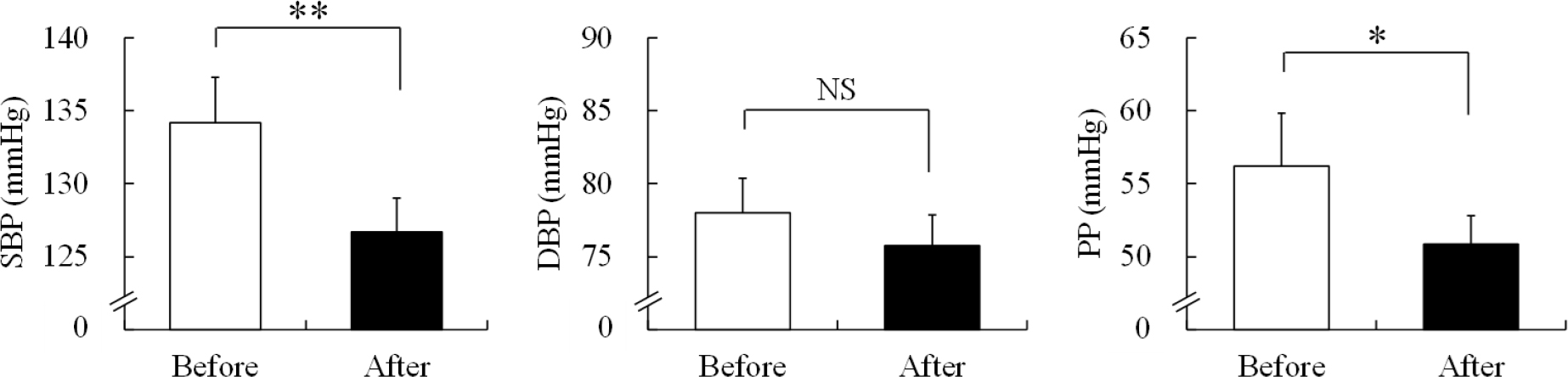
자연기반 아웃도어 활동 프로그램의 참여 전과 후의 혈압을 측정하였다. 프로그램 참여 전의 수축기 혈압(systolic blood pressure, SBP)은 134.2 ± 3.1이었으며, 참여 후 126.7 ± 2.3로 7.5 mmHg 감소하여 통계적으로 유의하게 감소하는 것으로 나타났다(p < 0.01). 확장기 혈압(diastolic blood pressure, DBP)의 경우, 프로그램 참여 전 78.0 ± 2.4, 참여 후 75.8 ± 2.06으로 2.2 mmHg 감소하였으나 통계적으로 유의하지 않았다. 한편, 프로그램 참여 전의 맥압(pulse pressure, PP)은 56.2 ± 3.6이었으며, 참여 후의 맥압은 50.9 ± 1.9로 5.3 mmHg 감소하여 통계적으로 유의하게 감소하는 것으로 조사되었다(p < 0.05) (Fig. 4). 이는 암환자를 상대로 진행한 연구 중 실험집단에서 수축기 혈압이 긍정적 효과가 있었던 Song 등(2015)Kim (2020)의 연구 중 보행실험에서 수축기·확장기 혈압 둘 다 유의하게 감소하였다는 연구와 유사하다.

자율신경계의 부교감신경계 활동을2 평가하기 위하여 심박변이도의 HF를 사용하였는데, 참여 전 137.98 ± 20.11, 참여 후 140.16 ± 14.16 ms2으로 변화하였고, 자율신경계의 교감신경계 활동을 평가하기 위하여 심박변이도의 자율신경 균형도 LF/HF를 사용하였는데, 참여 전 5.22 ± 2.28, 참여 후 3.88 ± 0.69로 변화하였다(Fig. 5).

실험 결과, 숲과 해양을 배경으로 수행된 숲길 트레킹, 해양레저 활동 등의 자연기반 아웃도어 활동 프로그램 참여 후 참가자들의 수축기 혈압과 맥압이 통계적으로 유의하게 감소하는 것으로 나타나, 스트레스 상태에서 활성화되는 혈압이 낮아져(Park and Miyazaki, 2008) 본 프로그램이 생리적 안정에 긍정적인 영향을 끼쳤음을 알 수 있었다. 이러한 결과는 숲이 있는 자연환경이 인체에 미치는 영향을 조사한 선행 연구 결과와 일치한다(Park et al., 2014; Joung et al., 2015; Song et al., 2015; Hong et al., 2019; Lee et al., 2020a; Ha et al., 2022).
https://cdn.apub.kr/journalsite/sites/kjoas/2024-051-01/N0030510102/images/kjoas_2024_511_9_F4.jpg
Fig. 4.

Changes in systolic blood pressure (SBP), diastolic blood pressure (DBP) and pulse pressure (PP) before and after the nature-based outdoor activity program. Data are presented as mean ± standard error (N = 25). Significance was verified by the paired t-test (DBP) and Wilcoxon signed-rank test (SBP and PP); *, p < 0.05; **, p < 0.01; NS, not significant.
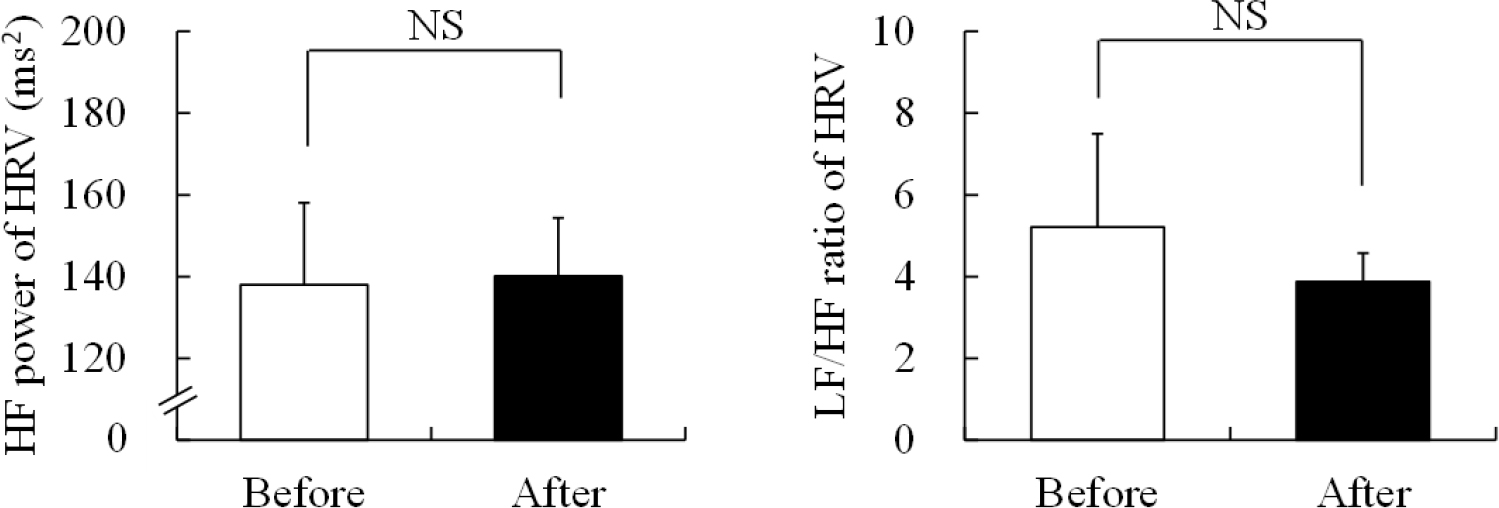
https://cdn.apub.kr/journalsite/sites/kjoas/2024-051-01/N0030510102/images/kjoas_2024_511_9_F5.jpg
Fig. 5.

Changes in HF power and LF/HF (low frequency/high frequency) ratio of HRV (heart rate variability) before and after the nature-based outdoor activity program. Data are presented as mean ± standard error (N = 25). Significance was verified by the Mann Whitney U-test. NS, not significant.

심리적 측정지표

한국판 PANAS를 사용하여 본 프로그램 참여 전과 후의 긍정적 정서와 부정적 정서를 평가하였다. 긍정적 정서의 경우, 참여 전 31.7 ± 1.2 점, 참여 후 35.4 ± 1.4 점으로 긍정적 정서가 3.7 점 증가하여 통계적으로 유의하게 높아지는 것으로 나타났다(p < 0.01). 부정적 정서의 경우, 참여 전 18.2 ± 1.0점, 참여 후 16.0 ± 1.0점으로 부정적 정서가 2.2점 감소하여 통계적으로 유의하게 낮아지는 것으로 나타났다(p < 0.05) (Fig. 6).

이는 숲을 걷고 경험하는 산림에서의 아웃도어 활동 프로그램이 소아(Yoo et al., 2011), 청소년(Kim et al., 2020a; 2020b), 대학생(Lee and Shin, 2019), 중년여성(Lee and Shin, 2015; Kim and Park, 2019), 베이비붐 세대(Sim et al., 2021), 노인(Wang et al., 2021; Kim et al., 2022)및 교사(Park et al., 2017), 소방공무원(Lee and Kim, 2021; Park et al., 2022; Park and Park, 2022) 등 다양한 연령대와 다양한 직무(Lee et al., 2018a; Ha et al., 2022)를 가지고 있는 이들에게 긍정적 영향을 미친다는 연구 결과와 일치한다. 또한, 산림과 물이 공존하는 시각적 환경이 인체에 긍정적인 영향을 미치고(Lee et al., 2009), 산림 내 호수 주변에서의 산책과 경관 감상을 통해 활력이 높아지고 기분 상태가 개선되며 불안감이 낮아진다(Song et al., 2015)는 연구 결과와 일치한다.

한국판 WEMWBS 척도를 이용하여 본 프로그램 참여 전과 후의 정신적 웰빙을 평가하였다. 그 결과, 프로그램 참여 전 51.21 ± 1.33점, 참여 후 53.03 ± 1.43점으로 프로그램 참여 후 정신적 웰빙이 1.8점 증가하여 통계적으로 유의하게 높아지는 것으로 나타났다(p < 0.05) (Fig. 7). 참가자들은 심리적으로 편안함을 느끼고 새로운 것에 대한 흥미와 관심을 가지고 자신뿐 아니라 미래에 대해서도 긍정적으로 생각하며 자신감이 높아진 것으로 나타났다.

이는 삶의 만족에 대한 기대가 높을수록 스트레스는 감소하고 웰빙이 증가하고(Kim, 2007), 스트레스가 높을수록 정신적 웰빙이 낮아진다(Lee et al., 2020b)는 선행연구의 논지와 일치한다. 또한, 자연환경에서의 아웃도어 활동은 평온함, 기운과 활력 같은 긍정적인 기분을 증가시켜 불안·분노 등 부정 정서를 보다 적게 느끼게 하며(Bowler et al., 2010), 특히 숲이라는 회복환경지각이 높을수록 정신적 웰빙이 높아진다(Lee et al., 2020b)는 것을 확인할 수 있었다.

한국판 회복 환경지각 척도를 이용하여 본 프로그램 참여 전과 후의 회복 환경지각정도를 평가하였다. 그 결과, 참여 전 91.90 ± 2.92점, 참여 후 102.76 ± 2.76점으로 수치가 10.86 증가하여 프로그램 참여 후 회복 환경지각 정도가 통계적으로 유의하게 높아지는 것으로 나타났다(p < 0.01) (Fig. 8).

참가자들은 일하느라 지친 머리를 쉬게 하고 고단한 현실에서 벗어나 즐겁게 지낼 수 있었으며, 하고 싶은 일을 할 수 있을 것 같다고 하였다. 또한 주위를 더 둘러보고 알고 싶어하는 호기심과 관심이 증가했다. 이는 자연환경 속에서 자연을 가까이 느끼고 행동할수록 삶에 대한 긍정적인 태도와 정서를 가지고 회복 효과가 커질 수 있으며 (Lee and Shin, 2015), 숲과 같은 자연환경은 심신의 스트레스 지수를 낮추고(Park, 2005) 훨씬 더 효과적인 회복 환경을 제공한다(Hartig et al., 2003)는 연구결과와 일치한다. 또한, 자연 속에서 긍정적인 회복 경험을 할수록 다시 자연을 찾게 되는 경우가 증가한다(Lee and Lee, 2020)는 연구와도 맥을 같이한다.
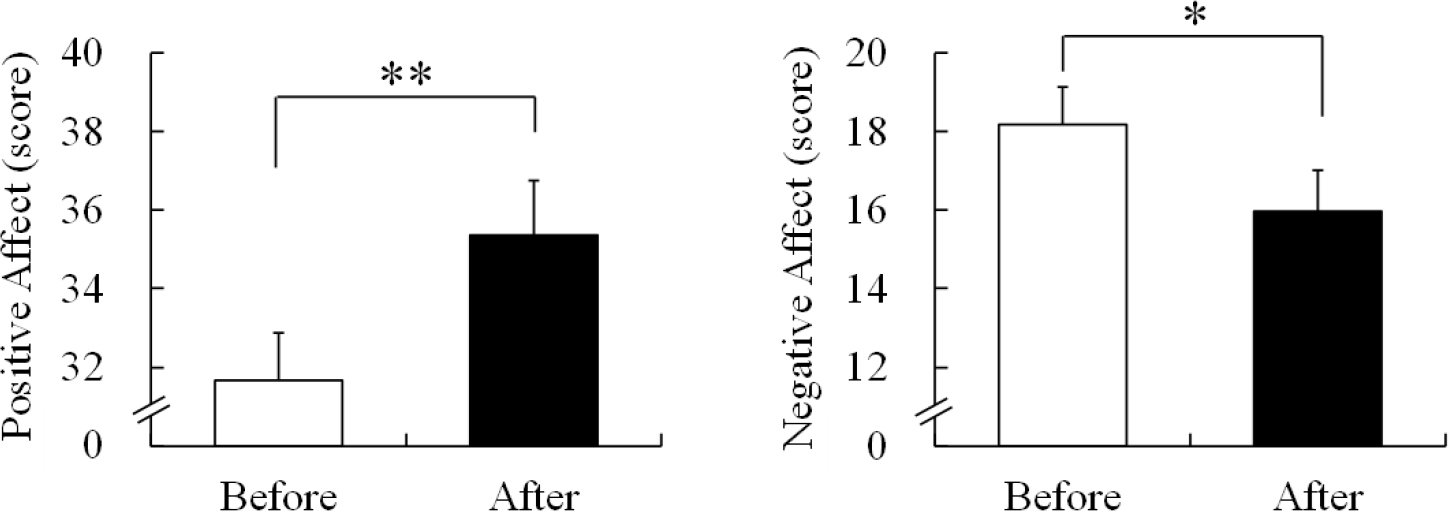
https://cdn.apub.kr/journalsite/sites/kjoas/2024-051-01/N0030510102/images/kjoas_2024_511_9_F6.jpg
Fig. 6.

Changes in positive affect and negative affect of PANAS (positive affect and negative affect schedule) before and after the nature-based outdoor activity program. Data are presented as mean ± standard error (N = 30). Significance was verified by the paired t-test (positive affect) and Wilcoxon signed-rank test (negative affect); *, p < 0.05; **, p < 0.01.
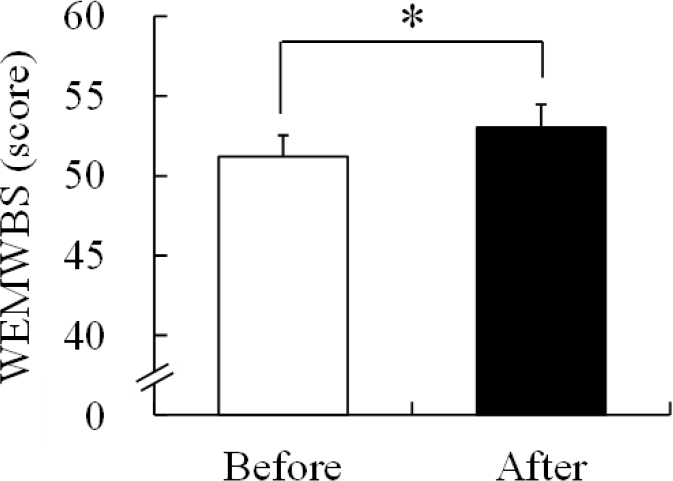
https://cdn.apub.kr/journalsite/sites/kjoas/2024-051-01/N0030510102/images/kjoas_2024_511_9_F7.jpg
Fig. 7.

Changes in positive affect and negative affect of PANAS (positive affect and negative affect schedule) before and after the nature-based outdoor activity program. Data are presented as mean ± standard error (N = 30). Significance was verified by the paired t-test (positive affect) and Wilcoxon signed-rank test (negative affect); *, p < 0.05; **, p < 0.01.
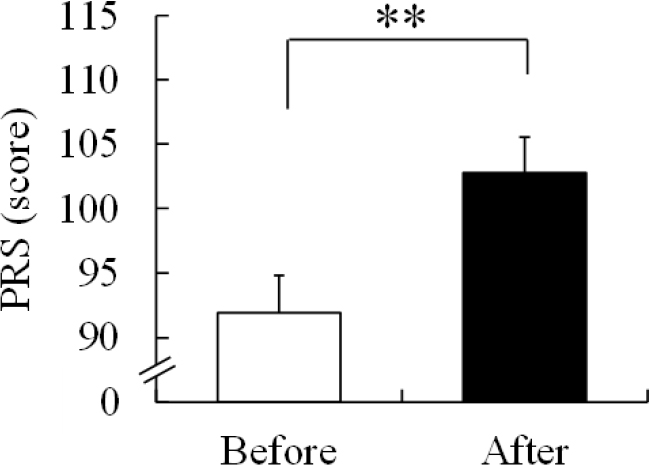
https://cdn.apub.kr/journalsite/sites/kjoas/2024-051-01/N0030510102/images/kjoas_2024_511_9_F8.jpg
Fig. 8.

Changes in positive affect and negative affect of PANAS (positive affect and negative affect schedule) before and after the nature-based outdoor activity program. Data are presented as mean ± standard error (N = 30). Significance was verified by the paired t-test (positive affect) and Wilcoxon signed-rank test (negative affect); *, p < 0.05; **, p < 0.01.

Conclusion

산림환경 및 해양환경을 배경으로 하는 자연기반 아웃도어 활동 프로그램에 참여한 참가자들은 수축기 혈압과 맥압이 감소하는 것으로 나타나 자연기반 아웃도어 활동 프로그램이 생리적 안정에 효과가 있음을 확인하였다. 또한, 프로그램 참여 후 참가자들의 긍정적 정서가 증가하고 부정적 정서는 감소하며, 정신적 웰빙과 회복환경지각도도 유의하게 증가한 것으로 나타나, 산림 및 해양자원을 바탕으로 하는 자연기반 아웃도어 활동 프로그램이 소방공무원의 생리·심리적 안정에 효과가 있음을 알 수 있었다.

본 연구에서는 생리적 측정 지표로 혈압, 맥압, 심박변이도 등 자율신경계 활동 지표 일부를 이용하였으나, 향후 다양한 지표를 통해 데이터를 축적하여 산림환경의 생리적 영향에 대해 검토할 필요가 있다. 또한, 참여자의 성별, 인원수를 보완하여 객관성을 높이는 동시에 피험자에 대한 사전 조사로 실험 결과의 정확성을 제고하고, 아울러 프로그램 종류별 비교 등 다양한 연구설계와 대조군 설정 등 후속 연구의 필요성도 있다.

그동안 산림치유의 선행연구는 주로 산림에서 수행해 왔으나 이번 연구를 통해 해양, 농업 등 다양한 자연기반 치유 분야와의 결합을 통해 연구 내용과 범위를 넓혀 복합적 사례가 더 많이 나올 수 있는 계기가 되길 기대한다. 또한, 소방공무원처럼 특수한 직업환경에서 스트레스 지수가 높은 응급의료 종사자, 경찰, 군인 등의 PTSD 고위험군 종사자에게 확대 적용되길 기대한다.


Conflict of Interests

No potential conflict of interest relevant to this article was reported.

Acknowledgements

본 연구는 2022년 국립공원연구원 정책연구과제로 수행되었습니다.

References

1

Baek ML. 2009. Posttraumatic stress by work in firefighters. Journal of the Korean Society of Hazard Mitigation 9(3):59-65. [in Korean]

2

Baek ML, Kim YR. 2016. Effect of music listening on convergent job stress of fire-fighter. Journal of the Korea Convergence Society 7(6):99-104. [in Korean]

10.15207/JKCS.2016.7.6.099
3

Benetos A. 1999. Pulse pressure and cardiovascular risk. Journal of hypertension. Supplement: Official Journal of the International Society of Hypertension 17:S21-S24

10706321
4

Bowler DE, Buyung-Ali LM, Knight TM, Pullin AS. 2010. A systematic review of evidence for the added benefits to health of exposure to natural environments. BMC Public Health 10:456.

10.1186/1471-2458-10-45620684754PMC2924288
5

Cacioppo JT, Berntson GG, Binkley PF, Quigley KS, Uchino BN, Fieldstone A. 1994. Autonomic cardiac control. II. Noninvasive indices and basal response as revealed by autonomic blockades. Psychophysiology 31:586-598.

10.1111/j.1469-8986.1994.tb02351.x7846219
6

Chae Y, Lee S, Jo Y, Kang S, Park S, Kang H. 2021. The effects of forest therapy on immune function. International Journal of Environmental Research and Public Health 18:8440.

10.3390/ijerph1816844034444188PMC8394293
7

Choi BK, Huh MK, Kim SY. 2015. Syntaxonomical and synecological research of forest vegetation on Mt. Byeokbang. Journal of Life Science 25:646-655. [in Korean]

10.5352/JLS.2015.25.6.646
8

Choi HH, Lee JH, Jung EY, Baek JE, Sung SY. 2022. Effects of marine healing program for reducing depression: A suggestion of healing tour for reducing 'Corona Blue' with marine healing program. Journal of the Korea Academia-Industrial Cooperation Society 23:704-712. [in Korean]

10.5762/KAIS.2022.23.2.704
9

Choi S, Lee S, Kim S, Song Y. 2016. A study on post-traumatic stress disorder (PTSD) and quality of life in firefightersfocusing on the moderating effect of resilience. pp. 349-372. In Proceeding of Korean Academy of Social Welfare 2016 Spring Conference. [in Korean]

10

Dempsey S, Devine MT, Gillespie T, Lyons S, Nolan A. 2018. Coastal blue space and depression in older adults. Health and Place 54:110-117.

10.1016/j.healthplace.2018.09.00230261351
11

Franklin SS, Larson MG, Khan SA, Wong ND, Leip EP, Kannel WB, Levy D. 2001. Does the relation of blood pressure to coronary heart disease risk change with aging? Circulation 103:1245-1249.

10.1161/01.CIR.103.9.124511238268
12

Ha KJ, Lee GY, Baek JH, An KW. 2022. The psychological and physiological changes of forest healing program experience on employees exposed to job stress. The Journal of Korean Institute of Forest Recreation 26:117-128. [in Korean]

10.34272/forest.2022.26.3.009
13

Hall M, Vasko R, Buysse D, Ombao H, Chen Q, Cashmere JD, Kupfer D, Thayer JF. 2004. Acute stress affects heart rate variability during sleep. Psychosomatic Medicine 66:56-62.

10.1097/01.PSY.0000106884.58744.0914747638
14

Hartig T, Evans GW, Jamner LD, Davis DS, Gärling T. 2003. Tracking restoration in natural and urban field settings. Journal of Environmental Psychology 23:109-123.

10.1016/S0272-4944(02)00109-3
15

Hartig T, Korpela K, Evans GW, Gärling T. 1997. A measure of restorative quality in environments. Scandinavian Housing and Planning Research 14:175-194.

10.1080/02815739708730435
16

Homan TD, Bordes SJ, Cichowski E. 2018. Physiology, pulse pressure. StatPearls Publishing, Treasure Island, FL, USA.

17

Hong S, Joung D, Lee J, Kim DY, Kim S, Park BJ. 2019. Effect of 2D forest video viewing and virtual reality forest video viewing on stress reduction in adults. Journal of Korean Society of Forest Science 108:440-453. [in Korean]

10.14578/jkfs.2019.108.3.440
18

Hur M, Park S, Kim H. 2020. Mental health education program development for new fire officials. Fire Science and Engineering 34(6):142-153. [in Korean]

10.7731/KIFSE.22aeffb7
19

Joung D, Yeom DG, Kim G, Park BJ. 2015. Physiological and psychological relaxing effects of viewing the scenery in the Jangseong Healing Forest. Journal of People, Plants, and Environment 18:429-435. [in Korean]

10.11628/ksppe.2015.18.5.429
20

Joung DW, Choi YH, Kim GW, Kwon CW, Im HJ, Park BJ. 2013. Psychological and physiological effects of viewing forest landscape in autumn season. pp. 1107-1109. In Proceeding of The Journal of Korean Institute of Forest Recreation. [in Korean]

21

Kanaya N, Hirata N, Kurosawa S, Nakayama M, Namiki A. 2003. Differential effects of propofol and sevoflurane on heart rate variability. Anesthesiology 98:34-40.

10.1097/00000542-200301000-0000912502976
22

Kannel WB, Gordon T, Schwartz MJ. 1971. Systolic versus diastolic blood pressure and risk of coronary heart disease: The Framingham study. The American Journal of Cardiology 27:335-346.

10.1016/0002-9149(71)90428-05572576
23

Kim BR, Jeong GC. 2020. Influence of post-traumatic stress on job satisfaction and turnover intention of firefighters: Moderating effect of internal and external control. Journal of the Korean society for Wellness 15(2):353-366. [in Korean]

10.21097/ksw.2020.05.15.2.353
24

Kim H, Lee K, Im H. 2020a. The influence of forest experience education programs on the relief of aggression and positive/negative emotions in adolescents. Studies on Korean Youth 31:107-135. [in Korean]

10.14816/sky.2020.31.4.107
25

Kim H, Park S. 2019. A Study on the relationship between urban forest experience and positive psychology of women in their 30s and 40s. The Journal of Korean Institute of Forest Recreation 23:37-47. [in Korean]

10.34272/forest.2019.23.2.004
26

Kim HJ, Lee G, Baek K, Kim C, Song I, Kang D, Seo S, Park K, Song C. 2022. Physiological and psychological effects of a forest healing program on elderly people with mild dementia. The Journal of Korean Institute of Forest Recreation 26:75-88. [in Korean]

10.34272/forest.2022.26.2.007
27

Kim IO, Shin WS, Jeon JY, Park SH. 2020b. The effect of forest therapy program on probationary juveniles' attitudes toward forest and angry. The Journal of Korean Institute of Forest Recreation 24:31-39. [in Korean]

10.34272/forest.2020.24.2.003
28

Kim IT, Lee JH, Jin YG. 2000. The vegetation of Hansan and Chubong Islets. Journal of Ecology and Environment 23:391-398. [in Korean]

29

Kim JH. 2007. The relationship between life satisfaction/life satisfaction expectancy and stress/well-being: An application of motivational states theory. Korean Journal of Health Psychology 12:325-345. [in Korean]

10.17315/kjhp.2007.12.2.003
30

Kim JH, Lee I, Yoo YG. 2019. Effects of a mind subtraction meditation-based healing program on the ruminations and posttraumatic stress disorder symptoms of firefighters. Fire Science and Engineering 33(5):118-129. [in Korean]

10.7731/KIFSE.2019.33.5.118
31

Kim JS. 2019. A study on the experiences regarding the healing of job performance stress of fire fighting officers. The Journal of the Korea Contents Association 19(5):520-531. [in Korean]

10.5392/JKCA.2019.19.05.520
32

Kim KH, Kim JW, Kim SH. 2006. Influences of job stressors on psychosocial well-being, fatigue and sleep sufficiency among firefighters. The Korean Journal of Occupational and Environmental Medicine 18:232-245. [in Korean]

10.35371/kjoem.2006.18.3.232
33

Kim KS. 2020. Influence of forest healing programs on health care of cancer patients: Mainly about physiological characteristics and psychological traits. Ph.D. dissertation, Chosun Univ., Gwangju, Korea. [in Korean]

10.22143/HSS21.11.5.2
34

Kim S, Jung HY, Na KS, Lee SI, Kim SG, Lee AR, Cho JT. 2014. A validation study of the Korean version of WarwickEdinburgh mental well-being scale. Journal of Korean Neuropsychiatric Association 53:237-245. [in Korean]

10.4306/jknpa.2014.53.4.237
35

Kim SK, Lee DH, Jang BR, Cheon S. 2015. The research trends on PTSD of workers in high risk public positions in Korea. The Korea Journal of Rehabilitation Psychology 22:393-416. [in Korean]

36

Kim SS, Kwon HR. 2002. Research about job satisfaction of 119 rescuers and emergency medical technicians. Korean Journal of Emergency Medical Services 6:169-184. [in Korean]

37

Kobayashi H, Ishibashi K, Noguchi H. 1999. Heart rate variability: An index for monitoring and analyzing human autonomic activities. Applied Human Science 18:53-59.

10.2114/jpa.18.5310388159
38

Lee B, Park CH, Park SJ. 2020a. Effects of long-term stay forest therapy program on user's positive and negative emotions and physical changes. Journal of Korean Society of Forest Science 109(4):544-552. [in Korean]

10.14578/jkfs.2020.109.4.544
39

Lee BK, Lee HH. 2012. A study on the effects of human physiology after forest phytoncide therapy. Journal of Naturopathy 1:14-20. [in Korean]

40

Lee DG, Jeong YM, Lee MM, Shin WS, Yoon YK. 2020b. The effect of socio-psychological stress on mental well-being mediated by perceived restorativeness: Focusing on visitors whose motive for visiting the Forest is 'COVID-19'. The Journal of Korean Institute of Forest Recreation 24:99-108. [in Korean]

10.34272/forest.2020.24.3.008
41

Lee GC, Park KJ. 2020. The effect of integrative art therapy using semantic therapy on the meaning of life of new fire officials. Journal of The Korean Society of Industry Convergence 23:1-8. [in Korean]

10.21289/KSIC.2020.23.1.1
42

Lee HR, Lee H. 2020. A study on the model of the self-determined motivation with perceived restorative environment in natured-based outdoor recreation context: Focused on mountaineering. Journal of Tourism and Leisure Research 32:333-352. [in Korean]

10.31336/JTLR.2020.10.32.10.333
43

Lee HS, Kang YH, Seon HM. 2020c. A study on the planning criteria for thalassotherapy facility. Journal of Navigation and Port Research 44:20-31. [in Korean]

10.5394/KINPR.2020.44.1.20
44

Lee JE, Shin WS. 2019. The effects of campus forest therapy program on university students emotional stability and positive thinking. Korean Journal of Environment and Ecology 33:748-757. [in Korean]

10.13047/KJEE.2019.33.6.748
45

Lee JH, Shin WS, Yeoun PS, Yoo RH. 2009. The influence of forest scenes on psychophysiological responses. Journal of Korean Society of Forest Science 98:88-93. [in Korean]

46

Lee JM, Kim JS. 2016. A study on the job attitude factors and job stress factors of fire-fighting officers: Focused on the correlation between factors and regulation effect of organizational trusts. The Korean Journal of Public Administration 25(3):61-90. [in Korean]

10.14774/JKIID.2016.25.6.061
47

Lee JM, Kim JS. 2021. A study on the resilience of fire-fighters: Analysis of the moderating effect on the relationship between job stress, job burnout, and job satisfaction. The Journal of the Korea Contents Association 21:690-701. [in Korean]

10.5392/JKCA.2021.21.10.690
48

Lee JW, Yeon PS, Park SH, Kang JW. 2018a. Effects of forest therapy programs on the stress and emotional change of emotional labor workers. The Journal of Korean Institute of Forest Recreation 22:15-22. [in Korean]

10.34272/forest.2018.22.3.002
49

Lee NY, Hah YS. 2012. Post-traumatic stress experienced by firefighters and paramedics. Perspectives in Nursing Science 9:83-93. [in Korean]

50

Lee SA, Lee SJ, Yook YS, Huh YJ, Lee MG, Choi HY, Lee JH. 2018b. Effects of a mindfulness-based mind-body intervention program using marine resources on the improvement of sleep quality and mood symptoms in Korean female emotional labor workers: A pilot study. Sleep Medicine and Psychophysiology 25:58-67. [in Korean]

10.14401/KASMED.2018.25.2.58
51

Lee SH, Hyun MH. 2003. The factor structure of the Korean version of the perceived restorativeness scale (PRS). Korean Journal of Health Psychology 8:229-241. [in Korean]

52

Lee YJ, Shin CS. 2015. Influence of forest healing user's nature relatedness, emotion, arousal state on stress recovery: Focused on women in their 50's. Journal of People, Plants, and Environment 18:123-128. [in Korean]

10.11628/ksppe.2015.18.2.123
53

Li Q. 2010. Effect of forest bathing trips on human immune function. Environmental Health Preventive Medicine 15:9-17.

10.1007/s12199-008-0068-319568839PMC2793341
54

NFA (National Fire Agency). 2022. 2022 National Fire Agency statistical yearbook. NFA, Sejong, Korea. [in Korean]

55

Paik YW, Choi MS. 2017. The effects of group arts psychotherapy on job stress and stress coping style for fire-fighting officers. Korean Journal of Arts Therapy 17(1):157-174. [in Korean]

10.18253/kart.2017.17.1.10
56

Park BJ. 2005. "Forest" a haven for modern people tired of stress. Forest and Culture 14:55-57. [in Korean]

57

Park BJ. 2010. An experimental approach to forest healing using forest recreation activities: Focusing on enjoying the scenery and taking walks. Ph.D. dissertation, Chungnam National Univ., Daejeon, Korea. [in Korean]

58

Park BJ, Ka JN, Lee MS, Kim SA, Park MW, Choi YH, Joung DW, Kwon CW, Yeom DG, Park S, et al. 2014. Physiological effects of walking and viewing on human at urban arboretums. Journal of Korean Society of Forest Science 103:664-669. [in Korean]

10.14578/jkfs.2014.103.4.664
59

Park BJ, Miyazaki Y. 2008. Physiological effects of viewing forest landscape: Results of field tests in Atsugi city, Japan. Journal of Korean Society of Forest Science 97:634-640. [in Korean]

60

Park CH. 2021. Effect of forest healing program on psychological and physiological improvement of firefighters. Master's thesis, Chungnam National Univ., Daejeon, Korea. [in Korean]

61

Park CH, Kang J, An M, Park SJ. 2019. Effects of forest therapy program on stress levels and mood state in fire fighters. Fire Science and Engineering 33:132-141. [in Korean]

10.7731/KIFSE.2019.33.6.132
62

Park CS. 2014. Redesigning education programs for alleviating disaster response officials' stress·PTSD and it's empirical analysis for effectiveness. Journal of the Korea Safety Management & Science 16:147-157. [in Korean]

10.12812/ksms.2014.16.4.147
66

Park H, Lee J, Min B, Kim JH. 2022. Korean firefighters' work experience and risk factors for depression during the COVID-19 pandemic. The Journal of the Korea Contents Association 22:446-455. [in Korean]

10.5392/JKCA.2022.22.05.446
64

Park HS, Lee JM. 2016. A validation study of Korean version of PANAS-revised. Korean Journal of Psychology: General 35:617-641. [in Korean]

10.22257/kjp.2016.12.35.4.617
65

Park JS, Park CG, Park MY, Park JH, Kim YH, Na JO, Shin SH, Suh SY, Hong SJ, Park SM, et al. 2004. Relation of blood pressure components to left ventricular hypertrophy and coronary heart disease with aging. Korean Circulation Journal 34:142-150. [in Korean]

10.4070/kcj.2004.34.2.142
66

Park S, Park BJ. 2022. Effects of forest healing program in urban forest on the mental health of fire officials and satisfaction. Journal of Recreation and Landscape 16:47-56. [in Korean]

10.51549/JORAL.2022.16.4.047
67

Park SH, Yeon PS, Hong CW, Yeo EH, Han SM, Lee HY, Lee HJ, Kang JW, Cho HS, Kim YH. 2017. A study on the effect of the forest healing programs on teachersʹ stress and PANAS. Korean Journal of Environment and Ecology 31:606614. [in Korean]

10.13047/KJEE.2017.31.6.606
68

Rho IS. 2020. Fire fighter's experience of trauma events, post-traumatic stress and job satisfaction. Korean Journal of Convergence Science 9(3):421-433. [in Korean]

10.24826/KSCS.9.3.26
69

Sim NS, Shin CS, Shin MJ. 2021. The effect of forest healing program on resilience and depression of baby boomer retirees. Korean Journal of Environment and Ecology 35:424-434. [in Korean]

10.13047/KJEE.2021.35.4.424
70

Song C, Lee J, Ikei H, Kagawa T, Miyazaki Y, Park BJ. 2015. Physiological and psychological effects of walking around and viewing a lake in a forest environment. Journal of Korean Society of Forest Science 104:140-149. [in Korean]

10.14578/jkfs.2015.104.1.140
71

Stewart-Brown S, Janmohamed K, Parkinson J. 2008. Warwick-Edinburgh mental well-being scale (WEMWBS) user guide version 1. Warwick Medical School, University of Warwick, Coventry, UK.

10.1037/t80221-000
72

TBS (Tongyeong Broadcasting System News Center). 2023. Hallyeohaesang Nature Center, an ecological tour in all seasons, is very popular with participating visitors. Accessed in http://www.tbs789.com/view.php?seq=13393&seq_cat=2 on 19 January 2023. [in Korean]

73

Tennant R, Hiller L, Fishwick R, Platt S, Joseph S, Weich S, Parkinson J, Secker J, Stewart-Brown S. 2007. The WarwickEdinburgh mental well-being scale (WEMWBS): Development and UK validation. Health and Quality Life Outcomes 5:63.

10.1186/1477-7525-5-6318042300PMC2222612
74

Wang G, Lee M, Lee E, Lee H, Park J. 2021. Effects of forest therapy program in urban forest on skeletal muscle mass, visceral fat and depression in elderly women: A case study of the Mt. Bibong in Anseong. Journal of Recreation and Landscape 15:35-42. [in Korean]

10.51549/JORAL.2021.15.1.035
75

Watson D, Clark LA, Tellegen A. 1988. Development and validation of brief measures of positive and negative affect: The PANAS scales. Journal of Personality and Social Psychology 54:1063-1070.

10.1037/0022-3514.54.6.10633397865
76

Yoon HS, Yoon H. 2022. A case study on the application of the happy arts therapy program to prevent mental health problems of fire-fighting officers. Official Journal of the Korean Society of Dance Science 39:1-27. [in Korean]

10.21539/Ksds.2022.39.1.1
77

Yoo Y, Lee SM, Seo SC, Choung JT, Lee SJ, Park SJ, Park CW. 2011. The clinical and immunological effects of forest camp on childhood environmental diseases. The Journal of Korean Institute of Forest Recreation 15:85-93. [in Korean]

10.34272/forest.2011.15.2.010
페이지 상단으로 이동하기