


Introduction
The conservation of native plant species plays a crucial role in safeguarding biodiversity and maintaining ecosystem resilience (Frankel et al., 1995). Korea harbors a rich diversity of native plant species, including legally protected taxa, many of which are increasingly threatened by climate change, habitat degradation, and anthropogenic disturbances (Chang et al., 2005; Kim, 2006). Conserving these plant resources requires not only protecting natural habitats but also securing seed resources and understanding species-specific seed traits and germination characteristics. Accordingly, the National Institute of Ecology is conducting research on the restoration and propagation of endangered plants and establishing optimal growth conditions and conservation strategies. For instance, studies have assessed the growth response of Sarcandra glabra under varying CO2 concentrations and organic matter contents to evaluate its restoration potential (Lee et al., 2018). In addition, the seed germination characteristics and dormancy types of Pedicularis hallaisanensis were investigated to suggest a method to improve germination rate through low temperature and gibberellin treatment (Park et al., 2024).
Understanding seed characteristics is a critical component of plant conservation research, as seeds represent a pivotal stage in the plant life cycle (Walters and Pence, 2021). The success of seed-based restoration and ex situ conservation efforts depends largely on species-specific traits such as germination behavior and dormancy. These traits are closely linked to each species’ ecological characteristics and adaptive strategies to their native environments (Baskin and Baskin, 2000). Some species exhibit highly specialized germination cues or prolonged dormancy, which can be easily affected by environmental changes in the habitat and human activities (Baskin and Baskin, 2020). Moreover, several endangered species are inherently limited by low germination or growth rates (Cerabolini et al., 2004; Wen and Yang, 2021), necessitating systematic studies of seed biology to overcome these challenges.
Seed traits are also intricately linked to genetic diversity, which influences germination capacity, growth vigor, and stress tolerance—key factors in formulating long-term conservation strategies (Guerrant et al., 2004; Saatkamp et al., 2019). By characterizing species-specific physiological and ecological traits, more targeted and successful propagation strategies can be developed. This study aimed to characterize the physical and morphological traits, germination performance, and estimated dormancy status of available seed lots from 18 plant species occurring in Korea. The study species included two legally designated Class II endangered wildlife species, Iris laevigata and Lychnis wilfordii (NIBR, 2026), as well as 16 species not legally designated as endangered. Because different species were represented in the 2020 and 2023 seed collections, the study was designed as a descriptive comparison among individual seed lots rather than as a controlled evaluation of collection year or storage duration. The resulting data are intended to provide baseline information for species-specific seed conservation and propagation.
Materials and Methods
Eighteen plant species were selected from seed lots available through ongoing seed collection and conservation activities at the National Institute of Ecology. Species selection was primarily based on the availability of sufficient seed material during the study period; consequently, the study species represent a range of taxonomic groups, growth forms, and conservation categories rather than a balanced representation of these groups. Seeds of the 16 species not legally designated as endangered were collected from mature plants in naturally occurring populations during field surveys in Korea. For the two legally protected species, Iris laevigata and Lychnis wilfordii, seeds were harvested from propagated plants maintained for ex situ conservation at the National Institute of Ecology. Seeds were collected in two separate years: Rosa rugosa, Caryopteris incana, Geum aleppicum, Patrinia scabiosifolia, Peucedanum japonicum, Iris ensata, Iris laevigata, Viburnum dilatatum, Veronicastrum sibiricum, and Atractylodes ovata in 2023, and Lychnis wilfordii, Iris sanguinea, Iris setosa, Abeliophyllum distichum, Dianthus japonicus, Dystaenia takesimana, Elsholtzia ciliata, and Codonopsis pilosula in 2020. The study species are distributed across various regions of Korea, ranging from localized habitats, such as Ulleungdo Island, to widespread distributions across the country (Fig. 1). All seeds were stored in dry, sealed containers at 4℃ until further analysis.
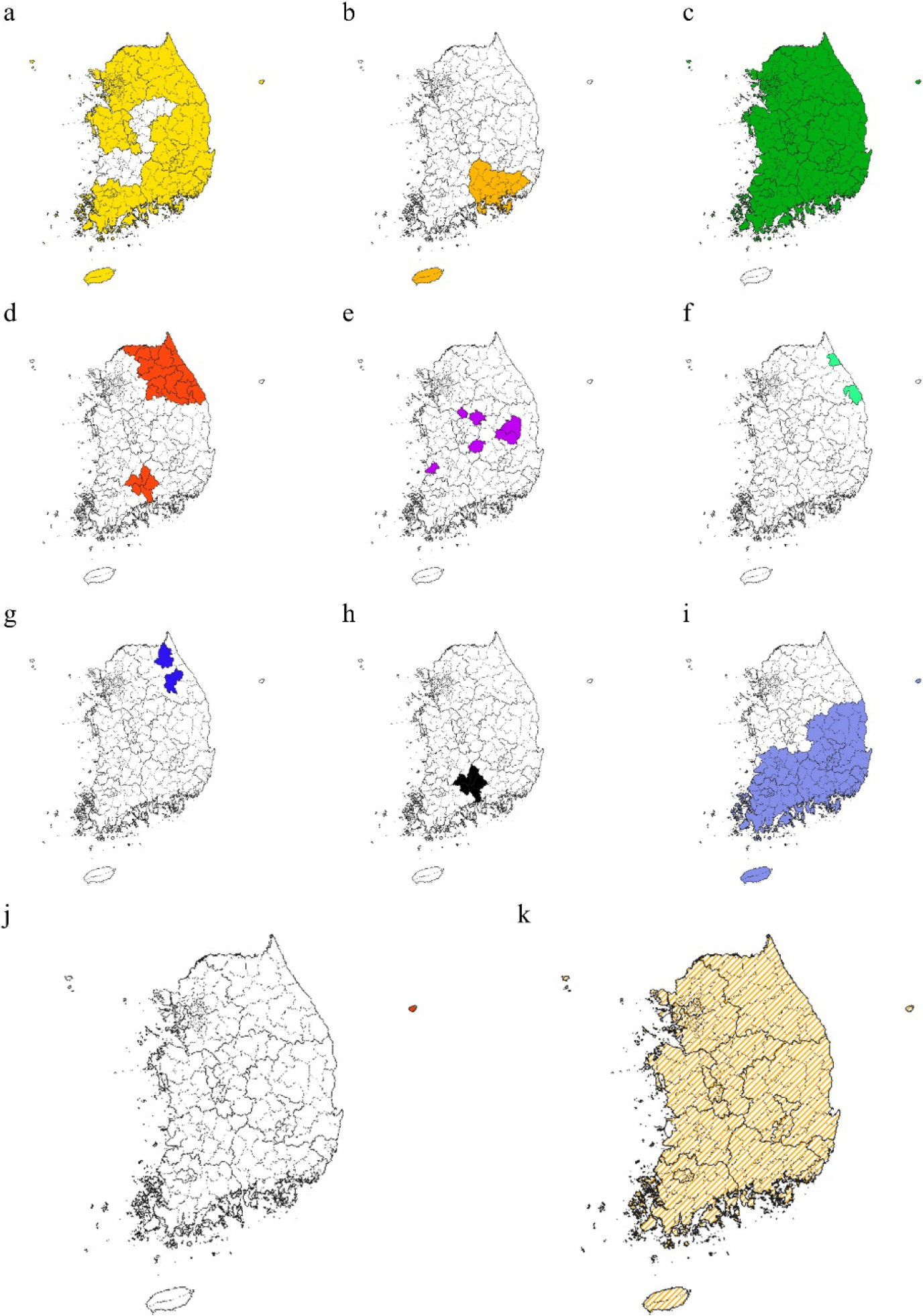
Fig. 1.
Reported geographic distributions of the 18 study species in Korea. Distribution data were obtained from the Biodiversity of the Korean Peninsula database of the National Institute of Biological Resources (17NIBR, 2026), and the maps were prepared by the authors based on these data. The maps show the known distribution ranges of the species and do not represent the exact seed-collection localities. a, Peucedanum japonicum; b, Dianthus japonicus; c, Veronicastrum sibiricum, Iris sanguinea; d, Codonopsis pilosula; e, Abeliophyllum distichum; f, Iris setosa; g, Lychnis wilfordii; h, Iris laevigata; i, Caryopteris incana; j, Dystaenia takesimana; k, Viburnum dilatatum, Iris ensata, Patrinia scabiosifolia, Atractylodes ovata, Geum aleppicum, Rosa rugosa, Elsholtzia ciliata.
To assess seed morphology, measurements of seed length, width, and thickness were performed using a vernier caliper. For each species, 20 individual seeds were measured. Because some seeds were very small, consistent positioning and alignment between the caliper jaws were difficult, and variation below the effective resolution of the overall measurement procedure could not be reliably distinguished. Therefore, for some species and dimensions, all individual measurements were recorded as the same value, resulting in a standard deviation of 0.00. Species with seeds that could not be measured with sufficient reliability were excluded from the quantitative morphological analysis. The 100-seed weight was determined in four replicates per species. Species with extremely small seeds (L. wilfordii, V. sibiricum, E. ciliata, and C. pilosula) were excluded from morphological analysis due to measurement limitations. Seeds of A. distichum and P. scabiosifolia were excluded from quantitative morphological measurements because seed deterioration prevented reliable assessment of seed dimensions and weight. However, the available seeds were included in the germination test and tetrazolium (TZ) viability assay.
Germination trials were conducted in controlled conditions at 25℃ in complete darkness. For each species, 20 seeds were placed on moistened filter paper within petri dishes. Germination was assessed after seven days, and seeds were considered germinated when the radicle had protruded at least 2 mm.
Seed dormancy was evaluated using a TZ viability assay. Seeds were immersed in 1% TZ chloride solution and incubated at room temperature (~25℃) for 4 h. Dormancy rate was inferred from the proportion of viable but non-germinated seeds based on TZ viability testing. Each test was conducted in four replicates per species.
Seed surface characteristics were examined using a Leica M60 stereomicroscope (Leica Microsystems, Germany). Focus stacking techniques were applied to obtain high-resolution composite images. Because seed deterioration prevented reliable imaging, A. distichum and P. scabiosifolia were excluded from the seed-surface morphology analysis.
All statistical analyses were conducted using SAS Studio software (SAS, 2018). Differences among species were evaluated using one-way analysis of variance (ANOVA) at a 5% significance level. Where significant differences were detected, Duncan’s multiple range test was applied for post hoc comparison of means.
Results and Discussion
A comparison of the physical and morphological characteristics of seeds from 18 plant species revealed distinct differences depending on the species (Table 1; Fig. 2). A. ovata had the narrowest seeds (0.10 cm), whereas I. ensata had the widest (0.55 cm). P. scabiosifolia had the shortest seeds (0.10 cm), whereas A. ovata had the longest (1.11 cm). Seed thickness could not be measured reliably in G. aleppicum, while R. rugosa had the greatest thickness (0.24 cm). The 100-seed weight was highest in V. dilatatum (1.59 g), followed by I. sanguinea (1.23 g) and I. setosa (1.20 g). Seed shape and coat structure also varied among species. These characteristics likely reflect evolutionary adaptation to habitat and may be related to dispersal strategies involving wind or water (Dehgan and Yuen, 1983). In particular, the four Iris species included in the study—I. ensata, I. laevigata, I. sanguinea, and I. setosa— showed similar external features, but differences among species were confirmed in thickness, length, and weight according to size.
Table 1.
Morphological characteristics of seeds from 13 of the 18 study species.
| Year | Plant | Width (cm) | Length (cm) | Thickness (cm) | Weight (g) |
| 2023 | Viburnum dilatatum | 0.44 ± 0.07a | 0.51 ± 0.07c | 0.17 ± 0.04bc | 1.59 ± 0.24a |
| 2023 | Peucedanum japonicum | 0.24 ± 0.04ab | 0.43 ± 0.04d | 0.15 ± 0.09cd | 0.18 ± 0.03de |
| 2020 | Dianthus japonicus | 0.20 ± 0.00b | 0.15 ± 0.00fg | 0.00 ± 0.00e | 0.13 ± 0.01de |
| 2023 | Iris ensata | 0.55 ± 0.14a | 0.63 ± 0.08b | 0.10 ± 0.00d | - |
| 2023 | Patrinia scabiosifolia | 0.20 ± 0.00b | 0.10 ± 0.00g | 0.10 ± 0.00d | 0.33 ± 0.02cd |
| 2020 | Iris setosa | 0.21 ± 0.04b | 0.47 ± 0.05cd | 0.22 ± 0.05ab | 1.20 ± 0.09b |
| 2020 | Iris sanguinea | 0.46 ± 0.60a | 0.44 ± 0.06d | 0.17 ± 0.07bc | 1.23 ± 0.06b |
| 2023 | Atractylodes ovata | 0.10 ± 0.00b | 1.11 ± 0.11a | 0.10 ± 0.00d | 0.23 ± 0.04de |
| 2020 | Dystaenia takesimana | 0.25 ± 0.05ab | 0.52 ± 0.07c | 0.23 ± 0.04a | 0.26 ± 0.04cde |
| 2023 | Iris laevigataz | 0.23 ± 0.09ab | 0.13 ± 0.06fg | 0.10 ± 0.00d | - |
| 2023 | Caryopteris incana | 0.19 ± 0.04b | 0.22 ± 0.06f | 0.10 ± 0.00d | 0.07 ± 0.01e |
| 2023 | Geum aleppicum | 0.16 ± 0.02b | 0.36 ± 0.05e | - | 0.15 ± 0.02de |
| 2023 | Rosa rugosa | 0.29 ± 0.06ab | 0.50 ± 0.04c | 0.24 ± 0.06a | 0.47 ± 0.10c |
Data are presented as the mean ± standard deviation (SD). Seed dimensions were measured using 20 individual seeds per species, and 100-seed weight was measured in four replicates per species. SD values of 0.00 indicate that all individual measurements were identical at the effective resolution of the vernier-caliper-based measurement procedure; these values should not be interpreted as indicating a complete absence of biological variation.
z A species designated as a Class II endangered wildlife species by the Ministry of Climate, Energy and Environment, Republic of Korea (NIBR, 2026).

Fig. 2.
Seed morphology of the study species. Images were obtained using a stereomicroscope and combined using a focus-stacking technique. a, Dianthus japonicus; b, Codonopsis pilosula; c, Dystaenia takesimana; d, Elsholtzia ciliata; e, Viburnum dilatatum; f, Iris ensata; g, Veronicastrum sibiricum; h, Atractylodes ovata; i, Iris laevigata; j, Iris setosa; k, Iris sanguinea; l, Lychnis wilfordii; m, Peucedanum japonicum; n, Caryopteris incana; o, Geum aleppicum; p, Rosa rugosa.
In addition to physical and morphological characteristics, germination and seed viability are important factors affecting plant reproduction and establishment (Linkies et al., 2010). In the present study, final germination percentage and the proportion of viable non-germinated seeds differed among the examined species (Fig. 3). The highest final germination percentage was observed in G. aleppicum collected in 2023 (83.0%), followed by L. wilfordii collected in 2020 (49.0%). Relatively high proportions of viable non-germinated seeds were observed in I. ensata (21.0%) and I. laevigata (10.0%) from the 2023 collection and in I. sanguinea (13.0%) and I. setosa (12.0%) from the 2020 collection. Among the woody species examined, A. distichum was the only species in which viable non-germinated seeds were detected. Although A. distichum was excluded from the morphological measurements presented in Table 1 and the seed images presented in Fig. 2 because of seed deterioration, it was included in the germination and TZ viability tests and is therefore presented in Fig. 3.

Fig. 3.
Final germination percentages and dormancy rates of the examined seed lots. Bars represent the mean ± standard deviation of four replicates per species. Collection year is presented as a seed-lot characteristic and was not analyzed as an independent experimental factor. z Species designated as Class II endangered wildlife species by the Ministry of Climate, Energy and Environment, Republic of Korea (17NIBR, 2026). a - d: Different lowercase letters indicate significant differences among species at p < 0.05 according to Duncan’s multiple range test.
Seed dormancy and germination can be influenced by species-specific traits, environmental conditions during seed development, maternal effects, initial seed quality, after-ripening, and test conditions (Penfield and MacGregor, 2017; Zhang et al., 2017; Baskin and Baskin, 2020). Seed longevity during storage also varies with storage temperature, seed moisture content, initial quality, and species (Solberg et al., 2020). In the present study, the 2020 and 2023 collections comprised different species; consequently, species identity, collection year, and storage duration were confounded, and their independent effects could not be separated. The observed differences should therefore be interpreted as characteristics of individual species and seed batches rather than as evidence of a storage-duration effect. Nevertheless, the variation among species indicates that species-specific germination and dormancy-breaking protocols are required for effective seed propagation.
The final germination percentages obtained in the present study differed from those reported in the Korea National Arboretum seed-information database for several species (Table 2). For example, the database reports germination percentages of 34.2% for L. wilfordii and 45.7% for I. laevigata, whereas different values were obtained from the seed lots examined in the present study. However, the two datasets were generated using different seed lots and may differ in collection year, seed source, initial seed quality, storage history, germination substrate, incubation conditions, and test duration.
Table 2.
Published seed-trait and germination data for the study species obtained from the Korea National Arboretum database.
The data presented in this table were obtained and modified from the Korea National Arboretum seed-information database (KNA, 2025). These values are provided as external reference data and are not directly comparable with the present results because seed source, collection year, germination substrate, incubation conditions, and test duration may differ between datasets.
The four Iris species examined in the present study—I. ensata, I. laevigata, I. sanguinea, and I. setosa—showed different germination percentages and proportions of viable non-germinated seeds. Previous studies indicate that germination inhibition in Iris seeds can involve mechanical constraints imposed by tissues surrounding the embryo, and that partial removal of the outer integument near the micropylar region can facilitate radicle emergence in some species (Blumenthal et al., 1986). Germination responses of I. dichotoma have also been evaluated under different incubation temperatures and after cold stratification, demonstrating the importance of testing germination treatments at the species level (Park et al., 2021). Furthermore, a comparative study of 20 Iris species revealed significant interspecific differences in germination percentage, dormancy type, dormancy depth, optimum temperature, and response to cold stratification (Zhu et al., 2022). In that study, physiological dormancy was reported in both I. setosa and I. laevigata, and 60 days of cold stratification increased germination in these species. These findings suggest that the differences among the four Iris species examined in the present study may reflect species-specific seed characteristics. Further studies should therefore evaluate scarification, stratification, and incubation-temperature treatments separately for each species.
Meanwhile, endangered plants face various threats due to climate change during restoration and propagation. Rising temperatures, disease spread, and increased competition can negatively affect their survival (Hong et al., 2021; Lee et al., 2024). In Korea, habitat changes associated with climate change have accelerated over the past 30 years, highlighting the need to secure genetic resources of endangered plants and develop climate-adaptation strategies (Cho et al., 2024). Seed propagation can contribute to maintaining biodiversity and adaptive capacity under environmental change (Harrison, 2017). In this study, germination percentage and estimated dormancy status varied among species. These results emphasize the importance of documenting seed source, initial quality, collection date, and germination-test conditions when developing species-specific conservation and propagation protocols. Seed propagation strategies should therefore account for species-specific germination requirements and well-documented collection and handling histories in conservation and restoration programs.
The establishment of a database that comprehensively analyzes various characteristics of seeds can contribute to the establishment of effective conservation and propagation strategies for native and endangered plants. The Korea National Arboretum has established a database of 1,570 plant seeds and made it available starting October 2024 (KNA, 2025). However, the existing database mainly focuses on the basic physical characteristics of seeds, and thus has limitations in accurately reflecting the physiological and ecological characteristics and environmental adaptation mechanisms of seeds. Therefore, in order to increase the effectiveness of conservation and propagation of native and endangered plants, this study proposes the need to establish an integrated database that comprehensively includes not only the physical characteristics of seeds but also germination physiology, dormancy mechanism, genetic diversity, and environmental responsiveness. This comprehensive database will increase the precision of seed conservation and propagation research and can be used as important basic data for establishing long-term plant conservation strategies. In addition, this database can be usefully utilized in risk assessment and safety management strategies for not only native and endangered plants, but also alien plants and genetically modified plants that may affect domestic biodiversity.
Conclusion
This study characterized seed morphology, germination performance, and estimated dormancy status in available seed lots from 18 plant species occurring in Korea, including the Class II endangered wildlife species Iris laevigata and Lychnis wilfordii. Seed dimensions, weight, surface structure, germination percentage, and the proportion of viable non-germinated seeds varied substantially among species. Because the species represented by the 2020 and 2023 collections were different, the independent effects of collection year and storage duration could not be determined. The observed differences should therefore be interpreted as characteristics of individual species and se`ed lots rather than as evidence that longer storage directly reduced germination or increased dormancy. Future studies should use seeds of the same species and populations, collected in the same year and assigned to standardized storage treatments, to evaluate storage effects experimentally. The present results provide baseline seed-trait information and support the development of species-specific germination protocols and an integrated database that includes seed source, collection history, morphology, viability, germination physiology, and storage conditions.