


Introduction
Materials and Methods
Results and Discussion
Earthworm survival during composting
Changes in C/N ratio during composting
Changes in pH during composting and effects on earthworm survival
Changes in EC during composting and effects on earthworm survival
Conclusion
Introduction
In Korea, improvements in dietary habits driven by economic growth and rising national income have led to a continuous increase in both meat consumption and livestock numbers. Consequently, the annual production of livestock manure has steadily risen, reaching approximately 50 million tons as of 2022. Among various livestock species, Cow (Korean native cattle) accounts for about 33.3% of the total manure production (KOSTAT, 2023).
The most common methods for recycling livestock manure are composting and liquid fertilization, with over 80% of the total manure undergoing fermentation processes before being returned to agricultural land (KOSTAT, 2023). However, excessive use of livestock compost can cause environmental issues, such as groundwater contamination and runoff into nearby rivers (Rieke et al., 2018).
Recently, vermicomposting using earthworms has gained attention as an environmentally friendly technology for organic waste management (Hwangbo and Jo, 2014; Jo and Hwangbo, 2014), as it reduces waste volumes while recycling valuable resources. Vermicomposting rapidly stabilizes livestock manure, suppresses odors and pests, and enables the complete utilization of the final product (Lee et al., 1992).
Several factors influence the effectiveness of vermicomposting in livestock manure management, including the temperature and moisture content of the manure, the carbon-to-nitrogen (C/N) ratio of the feed, and its physicochemical properties (Stafford and Tacon, 1984; Lee, 1995). Among these, the composting process, which alters the physicochemical characteristics of the manure to make it more suitable for earthworm consumption, is particularly crucial (Curry, 1976; Hartenstein et al., 1979).
Therefore, this study aimed to provide foundational data for the environmentally friendly treatment of livestock manure using vermicomposting by investigating the effects of physicochemical changes during the composting period on earthworm survival. Specifically, reed (Phragmites communis), commonly used as cow bedding and forage, was mixed with cow manure to improve the C/N ratio and promote the composting process.
Materials and Methods
The earthworms used in this study were Eisenia foetida, a species native to Korea. The experimental materials consisted of pure cow manure, excluding bedding and urine, collected from cows raised at the practice farm of Gyeongkuk National University, and chopped reed (P. communis) harvested as a forage resource in early June 2024. The cow manure and reed were mixed at four different volume ratios: 100 : 0 (CR0), 90 : 10 (CR10), 80 : 20 (CR20), and 70 : 30 (CR30) (cow manure : reed). The mixed feed for earthworms was supplemented with water to prevent excessive drying and to maintain a moisture content of 65 ± 5%. It was turned 3 - 4 times per week for a period of 6 weeks, and samples were collected at one-week intervals for analysis.
For physicochemical analyses, pH was measured according to the Soil Chemical Analysis Method (RDA, 1988) by mixing the compost with distilled water at a 1 : 5 ratio, stirring for 30 minutes, and measuring with a pH meter. Electrical conductivity (EC) was determined using an EC meter. Total nitrogen (TN) content was analyzed using the Kjeldahl method (AOAC International, 1995). Total carbon (TC) content was calculated according to the formula (100 - ash%) / 1.8 based on the method of the University of California, Berkeley (1953). The C/N ratio was derived from the TC and TN values.
The earthworm survival experiment was conducted for 6 weeks starting in early June 2024. Plastic containers were filled with 200 g of cow manure mixed with reed at different levels, and 10 earthworms were introduced into each container with three replications. Survival and escape of the earthworms were checked one week after introduction at weekly intervals.
All experimental data were analyzed using the SAS package program (SAS, 2023). Treatment means were compared by analysis of variance (ANOVA) followed by Duncan’s multiple range test at a 5% significance level.
The physicochemical characteristics of the cow manure and reed used in the experiments are shown in Table 1.
Results and Discussion
Earthworm survival during composting
The results of the earthworm survival test conducted weekly using cow manure mixed with varying levels of reed are presented in Table 2.
During the initial composting period (weeks 0 - 2), earthworms did not survive in any treatment group. However, starting from the third week of composting, a 100% survival rate was observed across all groups.
Table 2.
Earthworm survival over the composting period.
| Treatmentsz | Weeks of composting period (%) | |||||
| 1 | 2 | 3 | 4 | 5 | 6 | |
| CR0 | 0 | 0 | 100 | 100 | 100 | 100 |
| CR10 | 0 | 0 | 100 | 100 | 100 | 100 |
| CR20 | 0 | 0 | 100 | 100 | 100 | 100 |
| CR30 | 0 | 0 | 100 | 100 | 100 | 100 |
Changes in C/N ratio during composting
The changes in the C/N ratio of cow manure during the composting period are shown in Table 3.
In the CR0 treatment (100% manure), the C/N ratio decreased significantly from 26.20 at week 0 to 21.73 at week 6 (p < 0.05). In treatments mixed with reed, the C/N ratios ranged from 30.33 - 36.24 at week 0 to 24.76 - 27.34 at week 6, with higher reed ratios resulting in significantly higher C/N values (p < 0.05). Regardless of the initial C/N levels, all treatments exhibited a significant decrease in C/N ratio over time (p < 0.05). At the third week—when earthworm survival was first observed—the C/N ratio was 23.37 in CR0, and ranged from 27.45 (CR10) to 32.41 (CR40) in the reed-mixed treatments.
Microorganisms involved in manure composting utilize carbon as an energy source and nitrogen for growth and protein synthesis (Garcia et al., 1993). Generally, a C/N ratio of 25 - 35 is considered optimal for the early stages of composting. A C/N ratio that is too low can slow down composting and cause odor issues, while a ratio that is too high may limit nitrogen availability, thereby slowing microbial activity and decomposition (Bernal et al., 2009).
The initial C/N ratio of the manure used in this study was approximately 26.2 (Table 1), which is considered suitable for composting and within the optimal range for earthworm feed (15 - 30) (Shi et al., 2020). Nevertheless, earthworm mortality was observed during the initial 1 - 2 weeks of composting (Table 2). Despite the favorable C/N conditions, survival failure is presumed to be due to high fermentation heat (> 60℃) generated during the early composting stage (Lai et al., 2025), and toxic gas emissions associated with high temperatures.
As composting progresses, the organic matter in manure is decomposed through microbial respiration, leading to carbon loss as CO2, while nitrogen remains mostly conserved, resulting in a gradual decrease in the C/N ratio (Garcia et al., 1993). The earthworm survival-compatible C/N range observed in this study (23.37 - 32.41) is consistent with the optimal feeding range of around 25 (Lee, 1995).
Table 3.
C/N ratio according to mixture ratios of cow manure and reed.
|
Aging period (weeks) | Treatmentsz | ||||||||||||
| CR0 | CR10 | CR20 | CR30 | SEM | |||||||||
| 0 | 26.20 | c | A | 30.33 | bc | A | 33.21 | ab | A | 36.24 | a | A | 2.38 |
| 1 | 25.23 | c | AB | 29.78 | b | A | 32.26 | ab | A | 35.91 | a | A | 2.41 |
| 2 | 24.45 | c | AB | 28.23 | bc | AB | 31.31 | ab | AB | 33.51 | a | AB | 2.40 |
| 3 | 23.37 | b | AB | 27.45 | ab | AB | 30.47 | a | AB | 32.41 | a | AB | 2.55 |
| 4 | 22.78 | b | AB | 26.64 | ab | AB | 29.66 | a | AB | 30.56 | a | BC | 2.76 |
| 5 | 22.11 | c | B | 25.12 | bc | B | 28.12 | ab | AB | 29.90 | a | BC | 2.17 |
| 6 | 21.73 | b | B | 24.76 | ab | B | 26.88 | a | B | 27.34 | a | C | 2.40 |
| SEM | 1.98 | 2.41 | 2.64 | 2.69 | - | ||||||||
Changes in pH during composting and effects on earthworm survival
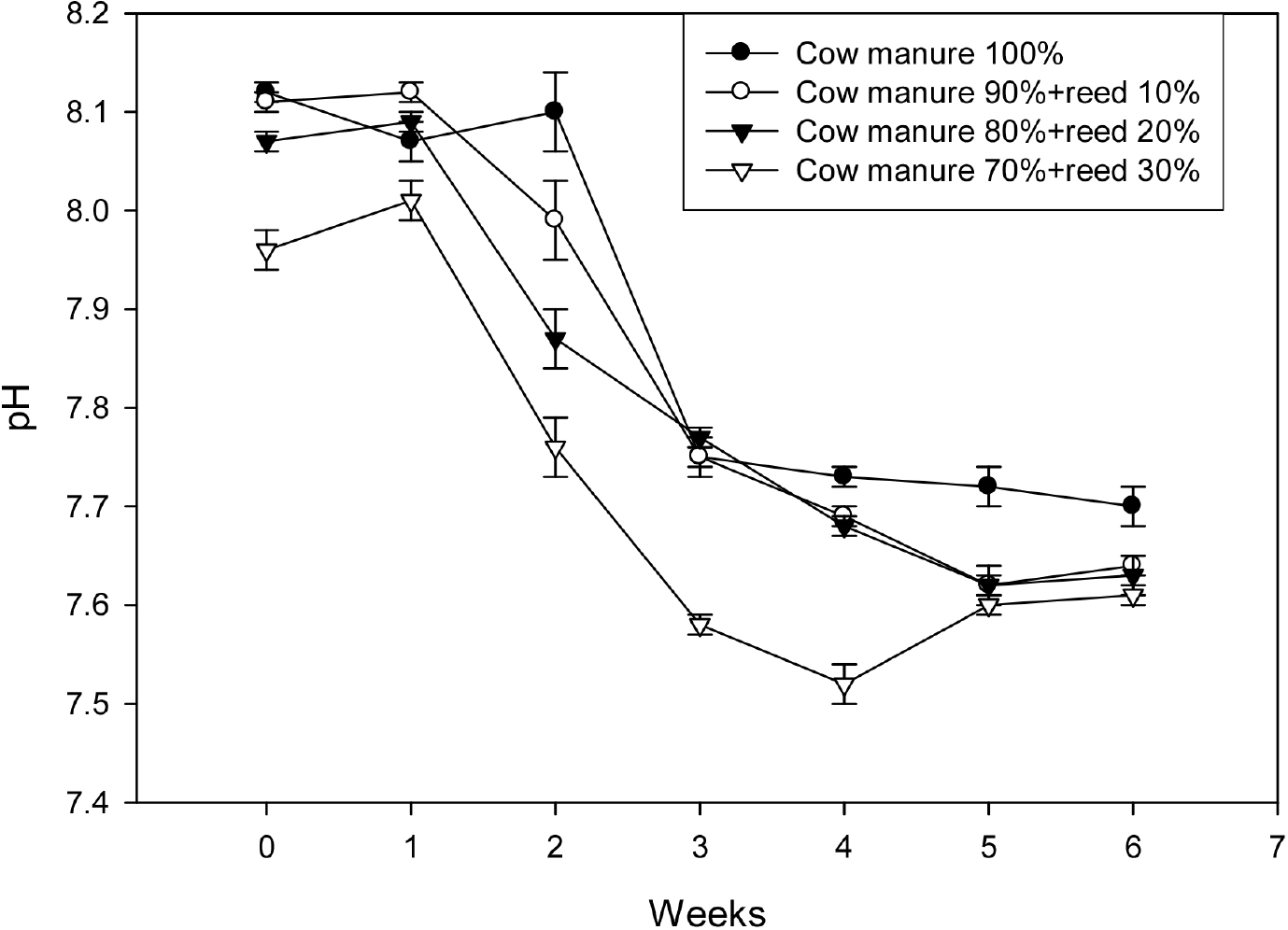
The changes in pH during the composting period are illustrated in Fig. 1.
At week 0, the pH of the CR0 group was 8.12, while the reed-mixed groups ranged from 7.96 to 8.11. Treatments with 20% or more reed exhibited significantly lower pH values compared to CR0 (p < 0.05). During the initial 1 - 2 weeks, pH tended to increase but then decreased steadily from week 3 onward (p < 0.05). By week 6, the pH stabilized at 7.70 for CR0 and between 7.61 and 7.64 for the reed-mixed groups. The pH at week 3, when earthworm survival was first noted, ranged from 7.58 to 7.77 across treatments.
In this study, the pH initially increased and then gradually decreased during composting, aligning with previous reports that pH rises due to ammonia production during early composting (Lee et al., 2005) and stabilizes to a range of 7 - 8 as composting progresses (Inbar et al., 1990).
Although optimal pH ranges for earthworm survival vary among species and researchers, earthworms generally prefer near-neutral conditions. Survival has been reported at pH 4.0 - 7.0 (Edwards, 1988), with 7.0 - 8.0 being suitable for E. foetida (Singh et al., 2020), and 5.5 - 6.5 being optimal (Na et al., 2000). The pH range observed at week 3 (7.58 - 7.77) was within these survival ranges.
Changes in EC during composting and effects on earthworm survival
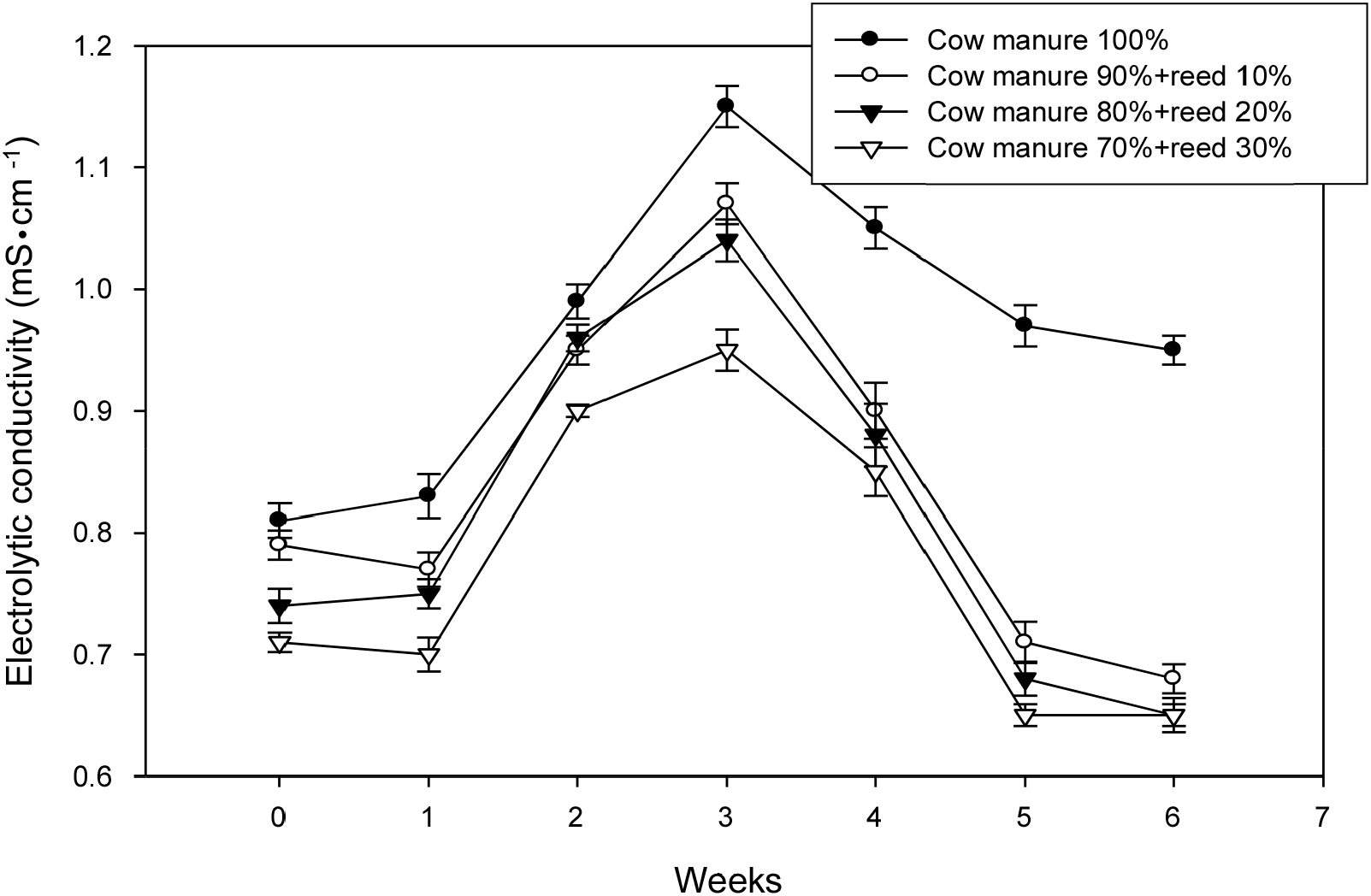
Changes in EC during the composting period are shown in Fig. 2.
At week 0, the EC of the CR0 group was 0.81 mS·cm-1, significantly higher than those of the 20% and 30% reed-mixed groups (0.71 - 0.74 mS·cm-1) (p < 0.05). EC increased during the first three weeks, reaching maximum values of 1.15 mS·cm-1 (CR0) and 0.95 - 1.07 mS·cm-1 (reed-mixed groups) at week 3 (p < 0.05), after which it gradually decreased, stabilizing at 0.95 mS·cm-1 (CR0) and 0.65 - 0.68 mS·cm-1 (reed-mixed groups) by week 6. The EC values at week 3, when earthworm survival began, were 1.15 mS·cm-1 for CR0 and 0.95 - 1.07 mS·cm-1 for the reed treatments.
Earthworms require sufficient moisture on their skin for respiration, and excessive soluble salts can impair survival. Therefore, EC measurement serves as an indicator of feed suitability for earthworms (Choi, 1992). Tolerance ranges for EC vary: Eisenia foetida can tolerate 1.95 - 4.9 mS·cm-1 (Choi, 1992), while Pheretima spp. can tolerate 0.75 - 15 mS·cm-1. Thus, the EC values observed in this study were within acceptable levels for earthworm survival.
During composting, EC values tend to rise as molecules ionize, influenced by increases in Cl-, NO3-, Ca2+, Mg2+, and P levels (Inbar et al., 1993). Typically, the highest EC levels are observed around week 2, after which they decline and stabilize (Huang et al., 2001). Similar trends were observed in this study, and reed addition appeared to dilute the concentration of dissolved ions, resulting in lower EC values compared to the pure manure treatment.
Overall, the physicochemical changes observed during the composting of cow manure mixed with various levels of reed produced conditions suitable for earthworm survival. However, further studies are necessary to evaluate the effects of different reed mixing ratios on earthworm growth and reproduction to optimize the efficiency of vermicomposting.
Conclusion
This study was conducted to provide foundational data for the environmentally friendly treatment of livestock manure using vermicomposting by investigating the effects of physicochemical changes during the composting period on earthworm (E. foetida) survival. To improve the C/N ratio and accelerate composting, Cow manure was mixed with reed (P. communis), commonly used as cow forage and bedding, at varying levels: 0% (CR0), 10% (CR10), 20% (CR20), and 30% (CR30). The key findings are summarized as follows:
Earthworms began to survive in all treatments starting from week 3 of composting. The C/N ratio was significantly higher in the reed-mixed treatments compared to the CR0 group (p < 0.05), with C/N values ranging from 23.37 to 32.41 at the third week, when earthworm survival was first observed. As the reed mixing ratio increased, both pH and EC tended to decreased with increasing reed mixing ratio, while the CR0 group showed the highest values. The pH and EC levels at the time of earthworm survival initiation ranged from 7.58 to 7.77 and 0.95 to 1.15 mS·cm-1, respectively.
Overall, the physicochemical conditions created by mixing cow manure with varying levels of reed remained within a suitable range for earthworm survival. However, further studies are required to investigate the effects of reed mixing ratios on earthworm growth and reproduction in order to optimize vermicomposting efficiency.